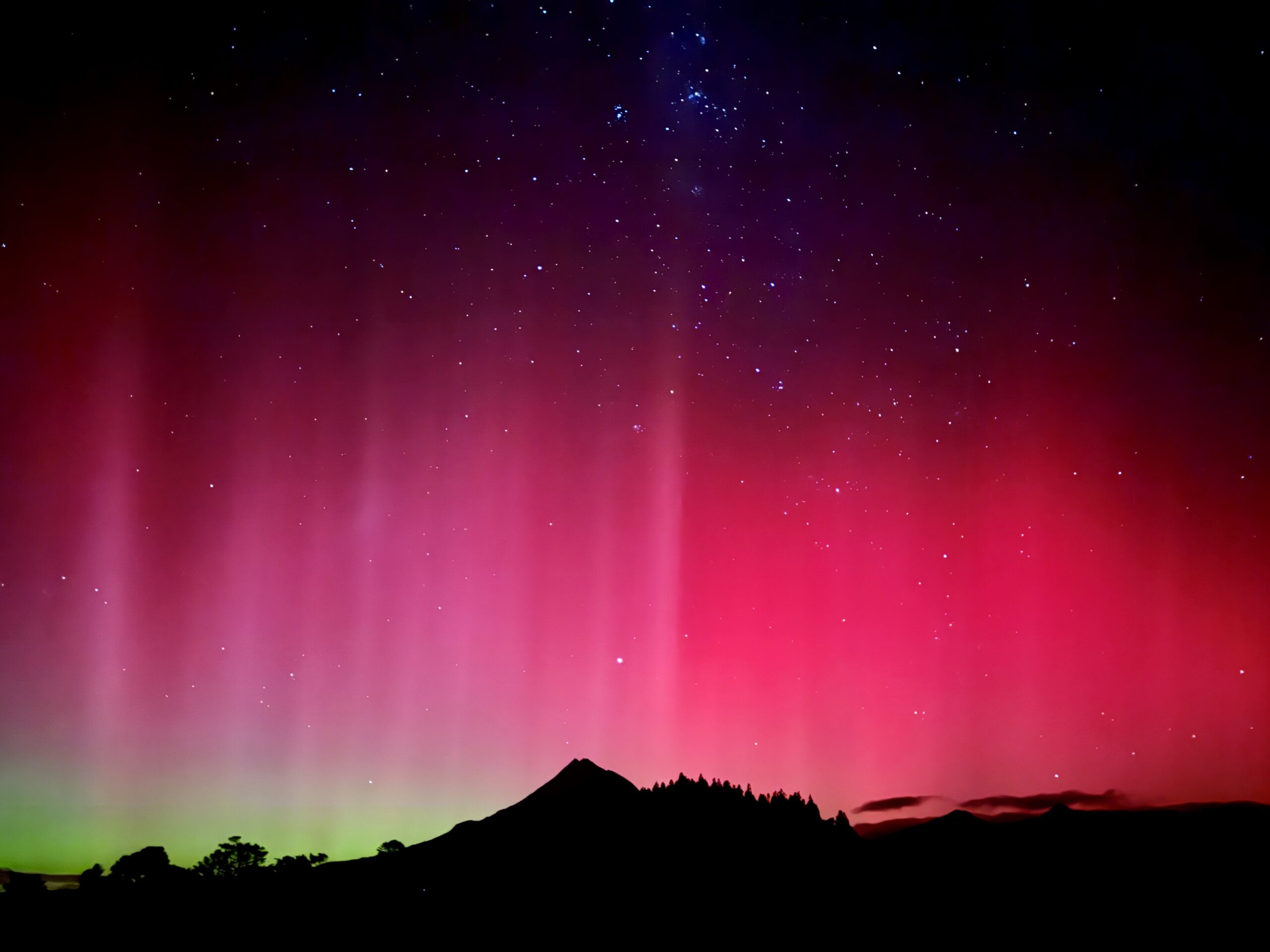

An intense burst of solar activity is giving Taranaki a chance of seeing the Southern Lights tonight, or at least capturing it with our phones, even if our eyes can’t quite see it.
A severe geomagnetic storm, driven by a series of recent eruptions on the sun called coronal mass ejections (CMEs), has pushed the auroral “oval” much further north than usual.
Similar storms over the past 24 hours have already produced vivid aurora australis displays across Australia and New Zealand, with reports of bright pinks, purples and greens as far north as parts of the North Island.
Space-weather forecasters expect activity to remain elevated tonight across our part of the world, meaning there is a realistic chance of the aurora being visible low on the southern horizon from Taranaki, particularly from darker rural locations with an unobstructed view.
Skies over New Plymouth and much of the region are forecast to be partly cloudy this evening and overnight, with some breaks. That’s not a guarantee, but it does mean windows of clear sky are possible, especially later at night.
What is the aurora?
For anyone new to the phenomenon, the aurora australis (Southern Lights) is a natural light display that happens high above Earth, roughly 80-400km up in the atmosphere. Charged particles streaming out from the sun (the solar wind) are guided by Earth’s magnetic field toward the polar regions.
When those particles crash into gases in our upper atmosphere, mainly oxygen and nitrogen, they transfer energy to those atoms and molecules. As the gases calm back down, they release that energy again as light.
Different gases and altitudes produce different colours: green is most common, with red, pink and purple also possible.
Normally these light shows are confined to a ring around Antarctica called the auroral oval.
During a strong geomagnetic storm like the current event, that oval expands, letting people much further north get a glimpse.
What’s causing tonight’s display
The current storm follows a burst of activity from a large magnetically complex sunspot region. Over recent days it has fired off several CMEs – huge clouds of plasma and magnetic field, in Earth’s direction. When these hit our planet’s magnetic field they disturb it dramatically, driving strong electric currents in space and in the upper atmosphere.
Space-weather agencies overseas have issued severe geomagnetic storm alerts, and New Zealand’s grid operator has already taken precautions for the power network. These storms can mildly affect satellites, radio communications and, in extreme cases, power systems.
But for most of us on the ground, the main impact is the possibility of a spectacular light show.
When Taranaki last saw a big aurora
Many Taranaki locals will remember the remarkable Mother’s Day weekend storm in May 2024, when the sky over Taranaki turned pink and red and social media filled with photos of the mountain backlit by curtains of light.
That event was driven by a rare G5-class geomagnetic storm – the strongest in more than 20 years. It produced aurora visible across almost all of the country, including Taranaki and much of the North Island.
Tonight’s storm is not guaranteed to match that “once-in-a-generation” display, but it’s strong enough that Taranaki has a genuine chance again, especially with the help of a camera.
How and where to look from Taranaki
- Face south. From Taranaki, the aurora will sit low on the southern horizon, not overhead.
- Get away from bright lights. Head out of town if you can – beaches, rural roads and elevated lookouts facing south are all good options. Even a short drive can dramatically cut light pollution.
- Give your eyes time to adjust. It can take 20-30 minutes in the dark for your night vision to really kick in. Avoid bright phone screens and car headlights where possible.
- Be patient. Auroral activity can come in bursts. It may be quiet for an hour, then suddenly ramp up.
If there is cloud around, look for breaks. Sometimes gaps will open up towards the south even when other parts of the sky look gloomy.
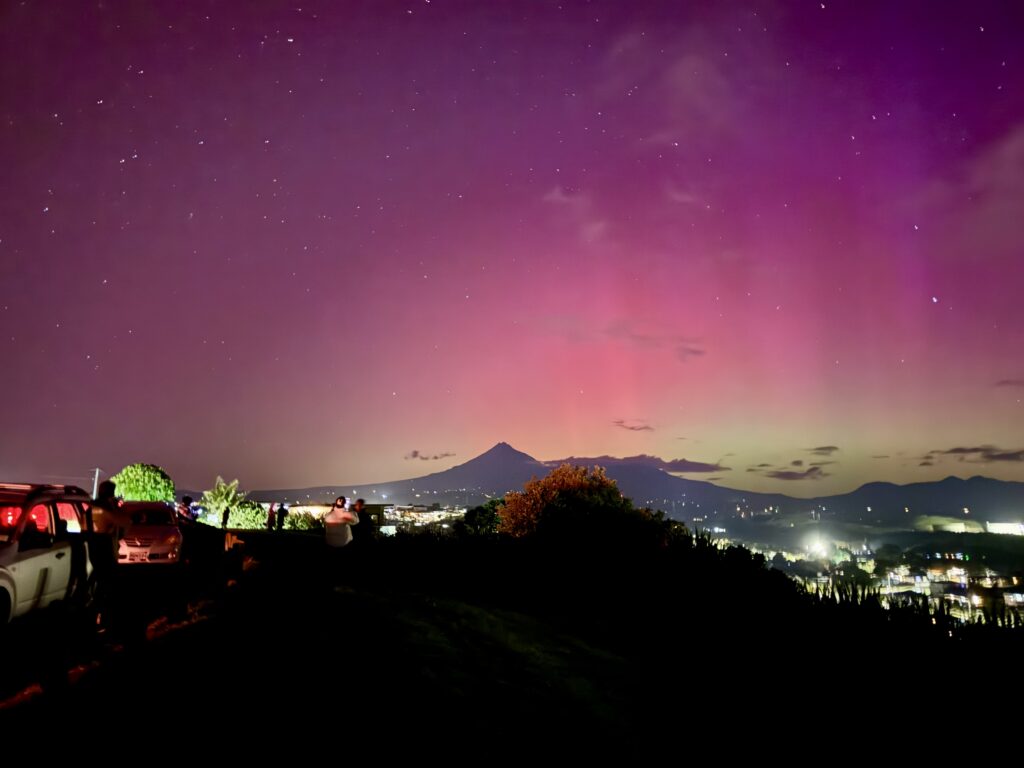
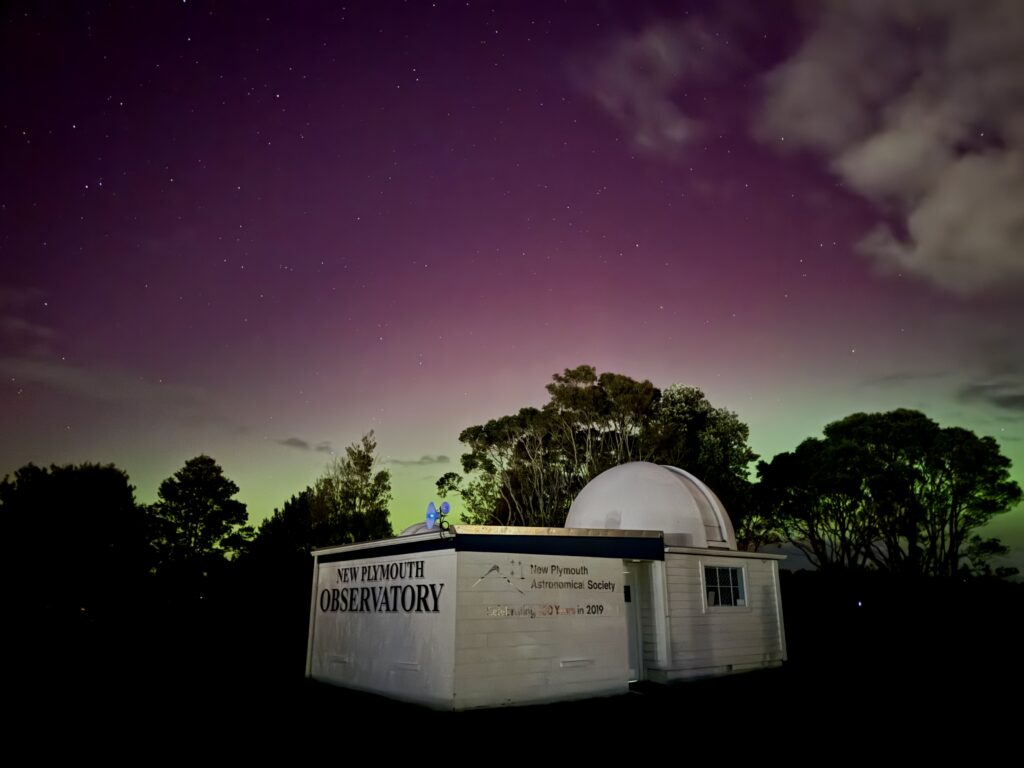
Here’s a timeline of locations I went to during the last big aurora in Taranaki, along with a sample of photos captured from my iPhone while waiting for long exposures on my mirrorless camera.
When looking at the times, keep in mind differences with daylight savings.
7:28pm – Mount Moturoa Domain
8:01pm – New Plymouth Observatory on Marsland Hill
8:50pm – Kent Road near Egmont Village
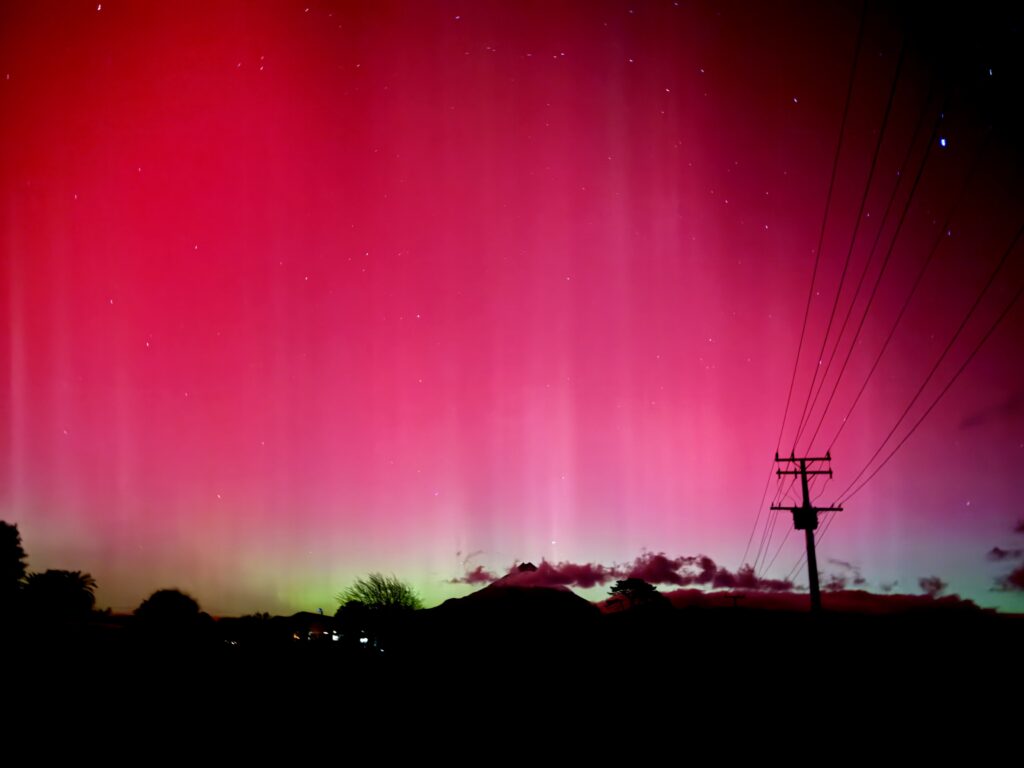
11:33pm – Peters Road off Egmont Road
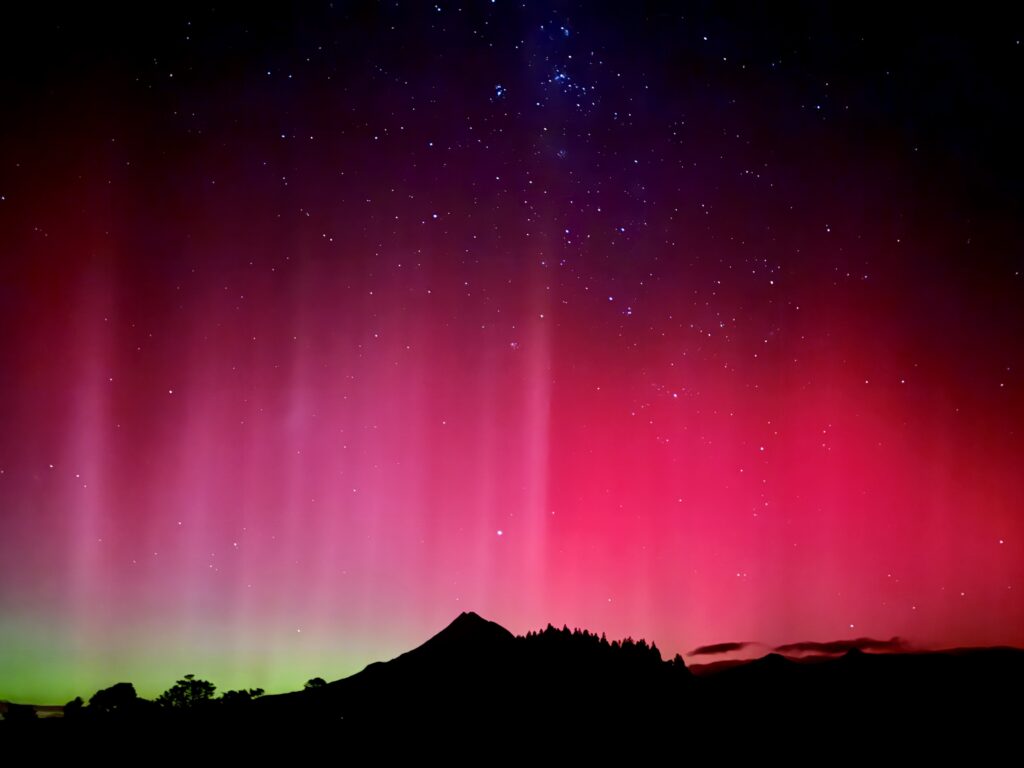
Why your phone might see more than your eyes
One confusing thing about auroras at our latitude is that they often look very faint or even invisible to the naked eye, yet show up vividly in photos. That’s because human eyes don’t work very well in low light. At night we rely on rod cells in our retinas, which are good at detecting brightness but poor at seeing colour.
Modern smartphone cameras on the other hand can gather light for several seconds in “night mode””” or with long exposures. The sensor quietly collects those faint photons over time and then brightens and colours the final image.
The result is that a patch of sky that looks like a greyish glow to you can appear as bright green or pink bands in your photo.
This same effect was widely reported during the May 2024 storms, when many people only realised there was an aurora after checking their phone screens.
In simple terms, if you step outside and can’t see anything, it’s still worth pointing your phone south and taking a long-exposure shot – the aurora might be hiding there.
Capturing the aurora with an iPhone
- Open the Camera app and swipe to “Photo” mode (not Portrait).
- If Night mode appears (a little moon icon), tap it and drag the exposure time slider up – ideally 5–10 seconds if you can hold the phone still, or up to 30 seconds if it’s on a tripod or stable surface.
- Point the camera south towards the darkest part of the sky, keep the phone as still as possible and tap the shutter.
- Review the image and zoom in – often the colours and bands will show up more clearly in the photo than you can see in real life.
A small tripod or phone clamp makes a huge difference. If you don’t have one, you can rest the phone on a fencepost, roof of the car or even a bag on the ground and use the self-timer so you’re not touching it when the exposure starts.
Capturing the aurora with Android phones
Android phones vary, but many recent models from Samsung, Google, Oppo and others have dedicated “Night”, “Starry Sky” or “Pro” modes that are ideal for aurora shots. In general:
- Look for a Night or Astro mode in the camera app and enable it.
- If you have a Pro/Manual mode, set:
- Focus to infinity (often shown as a mountain icon).
- ISO between 800–3200.
- Shutter speed between 5–20 seconds.
- As with iPhone, support the phone on a tripod or solid surface and use a timer to avoid shake.
Again, point toward the southern horizon and take a few test shots. Adjust ISO and shutter time until you start to see colour and structure in the sky.
Why long exposures reveal more detail
A long exposure simply means you are letting the camera’s sensor collect light for several seconds, rather than a tiny fraction of a second as in daytime photos. Because the aurora is usually quite faint in Taranaki, each pixel on the sensor needs time to accumulate enough light to stand out from the background.
During that time, the sensor is effectively adding up all the photons it receives from each part of the sky. Dim features that would be below the noise level in a normal snapshot become visible as smooth bands and curtains. That’s why 10-20 seconds of exposure can show clear green and pink structures even when your eyes only see a vague glow or nothing at all.
Manage expectations
While tonight’s forecast is promising, auroras are famously unpredictable. It’s possible that the storm will ease earlier than expected, or that cloud will get in the way. If you head out, be sure to tell someone where you’re going, and be prepared for the possibility that the sky will stay stubbornly quiet.
But with the sun nearing the peak of its 11-year activity cycle, events like this are likely to be more common over the next year or two. Even if tonight doesn’t deliver another May 2024-style spectacle, it is still a rare chance for Taranaki to be part of a global light show playing out over both hemispheres.