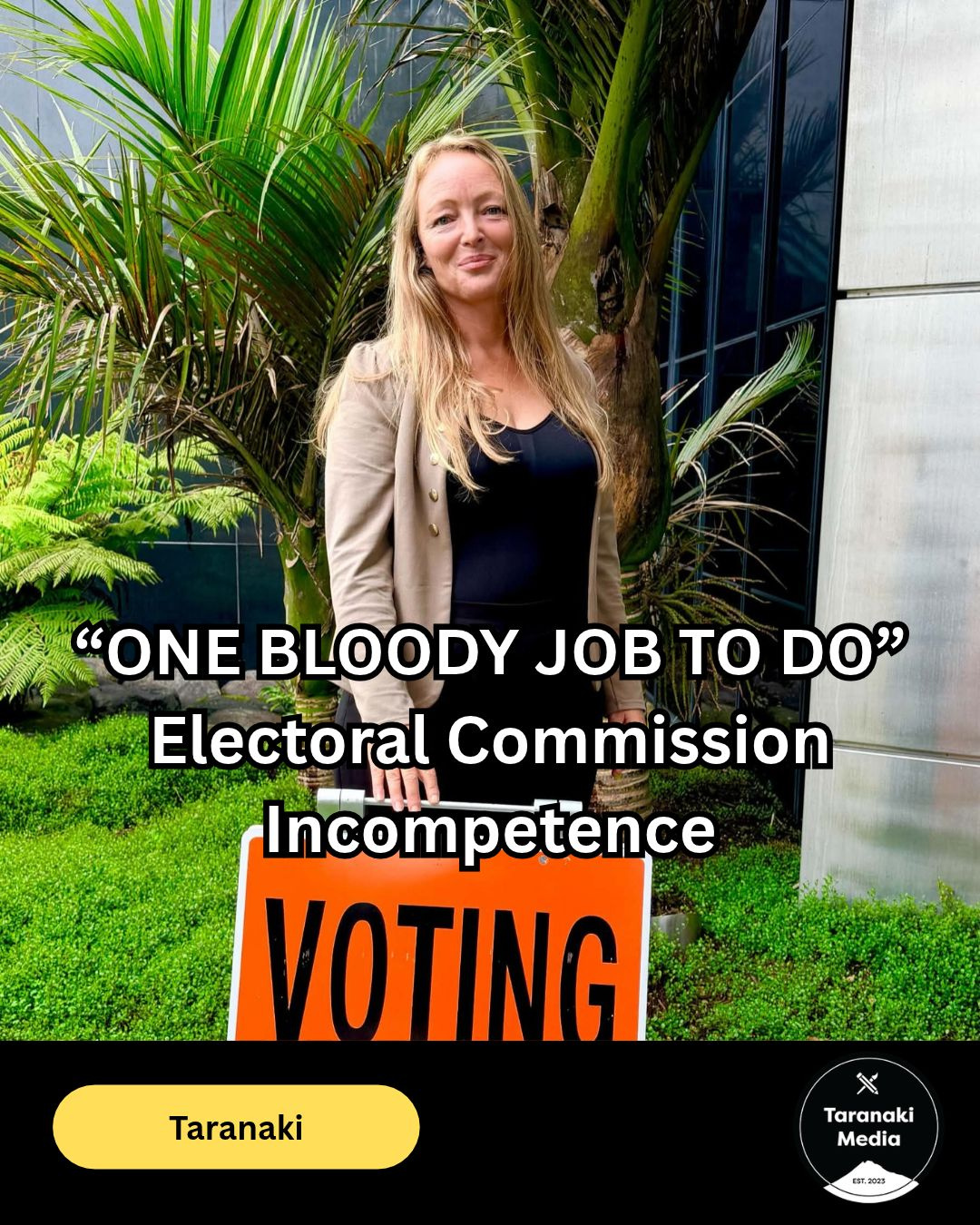

"JUST ONE BLOODY JOB TO DO!"
Editorial by Johanna Herbert
The fallout continues from Taranaki Media's breaking story on Sunday, which exposed another serious blunder by the Electoral Commission.
Taranaki Media revealed that people holding ineligible temporary visas had been sent electoral enrolment letters. The revelation followed an earlier incident in which a 17-year-old student was issued an EasyVote card, despite not being eligible to vote.
Former Attorney-General Chris Finlayson has since publicly questioned the integrity of the Commission's systems and called for its chief executive to be sacked.
The Taranaki Media story has boosted the media platform's viewership this week to more than 834,000 views, demonstrating the considerable public interest in the issue.
However, following questions from readers and sceptics about the accuracy of the reporting, Taranaki Media believes it is important to put the facts and timeline on the public record.
THE SCEPTICS
Some questioned how a relatively small regional media outlet had uncovered the story. Others demanded evidence and suggested Taranaki Media had not even approached the Electoral Commission for comment.
For that reason, copies of the Official Information Act request and the Commission's response are published below.
Readers are invited to examine them for themselves.
AN ELECTION WHERE EVERY VOTE MATTERS
New Zealand is heading towards what could be one of its closest general elections. Recent polling has pointed towards a potentially hung Parliament, with the balance of power likely to be finely contested.
Political divisions are running deep. Whatever their political allegiance, New Zealanders should agree on one principle: every eligible vote must count, and every ineligible vote must be excluded.
The people expect electoral integrity.
JUST ONE JOB
The Electoral Commission has one fundamental responsibility: to administer elections fairly, accurately and beyond question.
This is 2026. We live in an age of sophisticated technology, extensive databases and artificial intelligence. The Commission has had three years since the previous general election flaws to ensure its systems are fit for purpose.
So what happened this week?
MONDAY: THE OFFICIAL INFORMATION REQUEST
At 8.30am, Taranaki Media submitted an Official Information Act request to the Electoral Commission seeking answers about the enrolment letters sent to people who were apparently ineligible to vote.
A copy of the request is published below.
TUESDAY: THE COMMISSION RESPONDS
At 4.38pm, Taranaki Media received the Commission's response.
Readers can examine the full correspondence and decide for themselves whether the questions were adequately answered.
Later that evening, the editor of the Taranaki Daily News contacted the Commission to ask whether Taranaki Media had sought comment.
He was reportedly told that the Commission had received no enquiries from Taranaki Media.
There was, however, an important detail missing from that account.
The Commission had responded to Taranaki Media's Official Information Act request less than an hour earlier.
A TIMELINE THAT RAISES QUESTIONS
In its response, the Commission attributed the enrolment letters to a data-matching exercise with NZTA conducted between September 17 and September 24.
But Taranaki Media holds a copy of a letter sent to a working holiday visa holder, dated September 16 — one day before the data-matching exercise supposedly began.
That discrepancy deserves an explanation.
How could a letter have been issued before the data-matching process that the Commission says resulted in it being sent?
Taranaki Media believes this is a legitimate question that the public deserves answered.
WEDNESDAY: THE COMMISSION ADMITS THE PROBLEM
On Wednesday, the Electoral Commission published a statement acknowledging a significant problem with its enrolment systems.
It revealed that approximately 1,200 people had been added to the electoral roll when they should not have been.
The Commission said the people concerned included holders of temporary entry-class visas, such as work visa holders, and people whose visas had expired.
It further stated that their applications should have been flagged as ineligible, that they would be removed from the roll before the official count, and that anyone who had already voted would have their vote disallowed.
The admission raises further questions.
Why were these applications not flagged in the first place? How many people were affected? How confident is the Commission that it has identified every ineligible enrolment?
And, perhaps most importantly, how will it ensure that every affected enrolment and vote is properly accounted for?
The Commission has used the word 'approximately' when referring to 1,200 people. That may be understandable during an investigation, but the public needs certainty before the final results are declared.
WE SAY: DEMOCRACY DEMANDS ACCOUNTABILITY
Political parties come and go. Governments are formed and fall. Parliament makes laws and changes them.
But the integrity of the electoral process is fundamental to the legitimacy of every government elected in New Zealand.
Our system places considerable trust in voters. People can enrol without producing identification, relying instead on a signed declaration. Voters can also cast their ballots without presenting photo identification.
That makes the Commission's responsibility even greater.
The public is entitled to have confidence that the checks and safeguards are working.
This is not a left-versus-right issue. It is not about which political party might benefit. It is about protecting the democratic rights of every eligible New Zealander.
Taranaki Media is calling for a full explanation of what went wrong, how many people were affected, whether all ineligible enrolments have been identified and what safeguards will prevent this happening again.
The Commission owes the public an apology and a clear account of how it intends to restore confidence in its systems.
"Somebody, somewhere needs to be held accountable for the Commission's inexcusable incompetence. They’ve got just one bloody job to do" says Johanna Herbert.
___________________________________________________________________________
3 November 2026
Johanna Herbert
By email to: info@taranakimedia.nz
Kia ora Johanna
OFFICIAL INFORMATION ACT REQUEST 2026/101
On 2 November 2026 you made a request under the Official Information Act 1982 (the OIA) for the following information:
Please provide the following information regarding the issuance of enrolment invitation letters to temporary visa holders:
1. Is the Electoral Commission aware that invitation letters to enrol to vote have been sent to individuals currently in New Zealand on Working Holiday Visas?
2. If the Electoral Commission is aware of this occurrence, does it track or hold data on how many of these letters have been issued to Working Holiday Visa holders or other ineligible temporary visa categories? If so, please provide the total number issued over the most recent tracking period or election cycle.
3. What specific protections, verification measures, or systematic checks are currently in place (other than relying on an honesty policy when an individual fills out the enrolment form) to prevent ineligible temporary visa holders from successfully enrolling to vote?
Please find the response to your request below.
Processes to ensure only eligible electors are added to the roll
Pursuant to section 263B of the Electoral Act 1993 (‘the Act’), the Electoral Commission (the
Commission) can undertake a datamatch with New Zealand Transport Agency’s (NZTA’s) database of Driver Licence Information and the Motor Vehicle Register against the electoral roll. The match is to highlight both unenrolled NZTA clients and electors whose NZTA address details are more recent than that on the electoral roll.
We undertook a datamatch with NZTA between Thursday 17 September and Thursday 24 September 2026. Further information is available here.
If we identify persons that are not enrolled, a letter is sent to them about the enrolment process.
To be eligible to enrol and vote, a person must be 18 years or older, a New Zealand citizen or resident for electoral purposes, and must have lived in New Zealand continuously for 12 months or more at some time in their life. A person is resident for electoral purposes if they are living in New Zealand lawfully and are not required to leave within a specified time.
People can be eligible to hold a driver licence and register a motor vehicle that are not eligible to enrol and vote. For that reason, any enrolment application received also goes through a datamatching process with Immigration New Zealand (INZ) under section 263A of the Act to make sure that only persons eligible to enrol are enrolled to vote.
The Commission gets a file daily from Immigration NZ (INZ) of people who are in New Zealand unlawfully or here lawfully but with a date by which they must leave NZ which means they are not ‘resident for electoral purposes’ under section 73 and not eligible to enrol and vote.
If we get a match with the INZ data, we send correspondence to the person indicating that we have information to suggest they are not qualified and inviting them to provide evidence to satisfy the Commission that they are. Failure to provide information results in the enrolment application not being progressed. Anyone enrolled that is subsequently identified in an INZ match, is removed from the roll and served notice.
In the interests of transparency, we release responses to Official Information Act requests every 3 months. We will publish this response with your personal details redacted.
You have the right under section 28(3) of the Act to make a complaint to the Ombudsman if you are not satisfied with the response to your request. Information about how to do this is available at www.ombudsman.parliament.nz or by phoning 0800 802 602.
Yours sincerely
Kristina Temel
Chief Legal Advisor