
Contact Energy Pushes Stratford Data Hub as Consent Test Nears
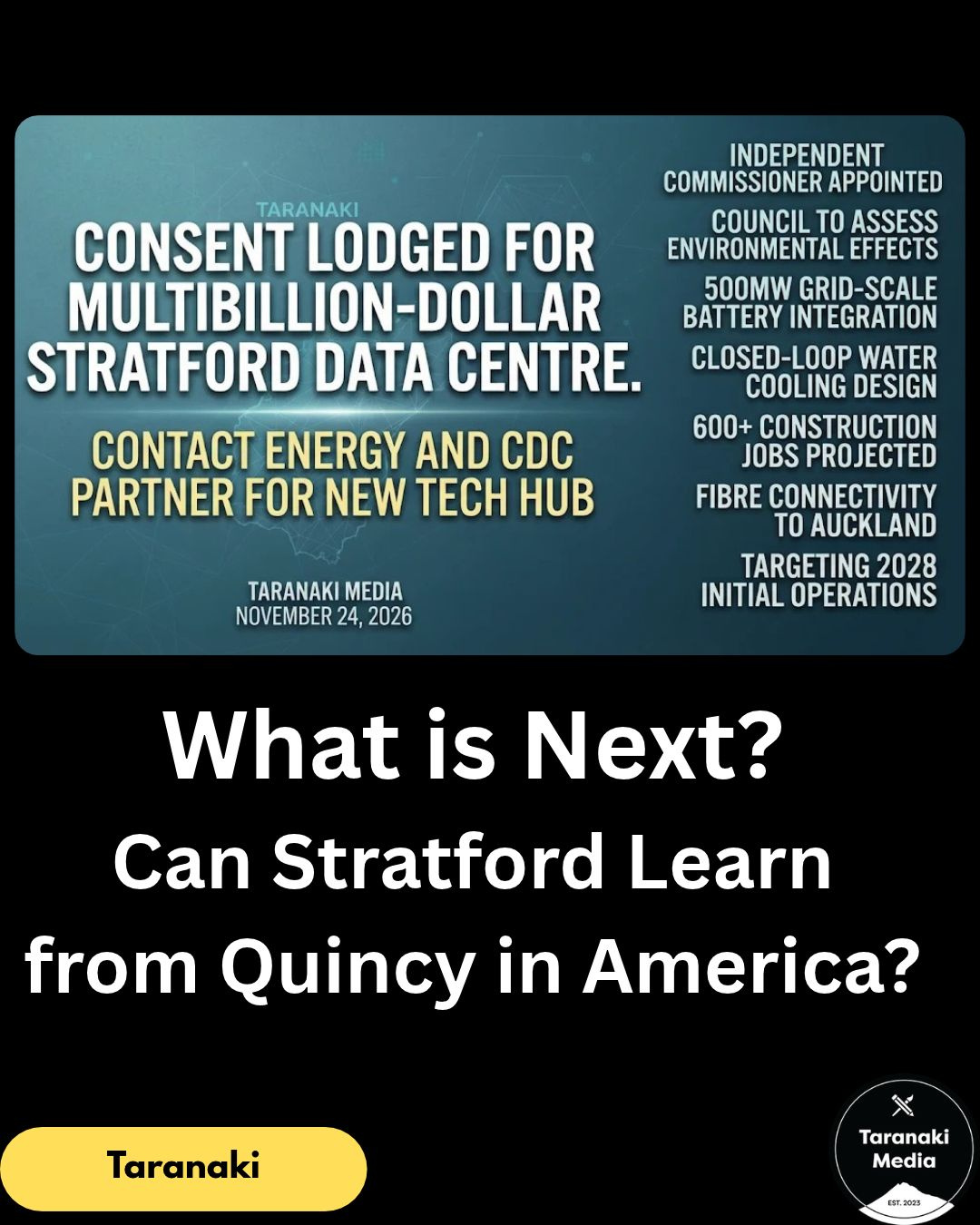
Plans for a proposed 250-megawatt data centre at Stratford have moved into the formal consenting stage, with Contact Energy and partner CDC Data Centres lodging a resource consent application with the Stratford District Council near the retired Taranaki Combined Cycle gas power station.
Under New Zealand's Resource Management Act, whether an application is publicly notified depends on set legal tests rather than project popularity or economic hopes.
A council or independent commissioner first checks if a district plan or national environmental standard requires public notification, or if the applicant requests it. Otherwise, the decision turns on whether the proposed activity will have, or is likely to have, adverse environmental effects that are more than minor, leaving economic benefits outside that notification test.
A council must also publicly notify if special circumstances warrant wider public input, or use limited notification for specific people if adverse effects on them are minor or more than minor and written approval has not been given.
Contact Energy chief executive Mike Fuge told the Taranaki Daily News that the company put heavy effort into getting the consent ready so environmental conditions, including noise, were properly addressed. In Contact's project documentation and NZX market announcements, the facility is estimated at 250 megawatts of IT compute load and around 350 megawatts of peak total load including ancillary demand, depending on final design, while existing 200-megawatt generation assets at Stratford would not be affected.
Fuge said in Contact's joint announcement with CDC that the company aims to lead New Zealand's renewable energy future while supporting regional economic regeneration.
"Our strategy is to lead New Zealand's renewable energy future. And, as part of that, we are playing our part in the economic regeneration of the regions," Fuge said. "We believe Stratford shapes as an ideal location to explore a digital hub powered by renewable energy from where the local Taranaki economy can thrive, and the wider energy system and New Zealand can benefit."
Contact notes that Stratford already has an existing electricity grid connection point needing only minor substation works, along with fibre routes linking north toward Auckland. The company also highlights Taranaki's cooler temperatures for free air cooling much of the year, alongside closed-loop water cooling and rainwater collection to keep water demand low, while acoustic engineering such as enclosures and silencers is designed to bring outdoor cooling noise down to around 40 decibels beyond the property boundary.
Commercial hurdles still sit ahead before construction can start, with Fuge noting that securing financing and an international anchor customer remain key before a targeted final investment decision in mid-to-late 2027 and potential initial operations by the end of 2028. Investment bank UBS has benchmarked a hyperscale facility of this scale at between $4.5 billion and $5 billion, while Fuge noted the wider push alongside renewable builds across New Zealand, including $2.25 billion in priority projects such as Stratford Solar, Tauhara 2 geothermal and Southland Wind, could reach $7 billion to $8 billion in total investment.
As Stratford weighs this shift from gas to digital infrastructure, lessons from Quincy in central Washington state offer a useful comparison. Quincy has a population of about 8,510 people and has hosted large data centre developments, including Microsoft facilities, since 2007.
Reporting on Quincy shows clear financial upsides alongside ongoing pressures: municipal tax revenue has supported community projects and local poverty rates dropped over a decade, yet residents and analysts have raised concerns about electricity and water demand, grid strain and modest permanent job numbers once building wraps up.
For Stratford and the wider Taranaki economy, the Quincy experience shows the value of clear commitments upfront on power pricing, water and noise controls, and local benefits. Contact expects peak construction jobs to sit around 600 roles, comparable to the Tauhara geothermal build, alongside roughly 400 associated positions and about 200 permanent roles once running, while CDC founder and chief executive Greg Boorer said in the joint announcement that the project can support national resilience, local ownership and long-term regional participation.
What questions should be settled first as the Stratford data centre consent moves ahead? Share your thoughts in the comments below!