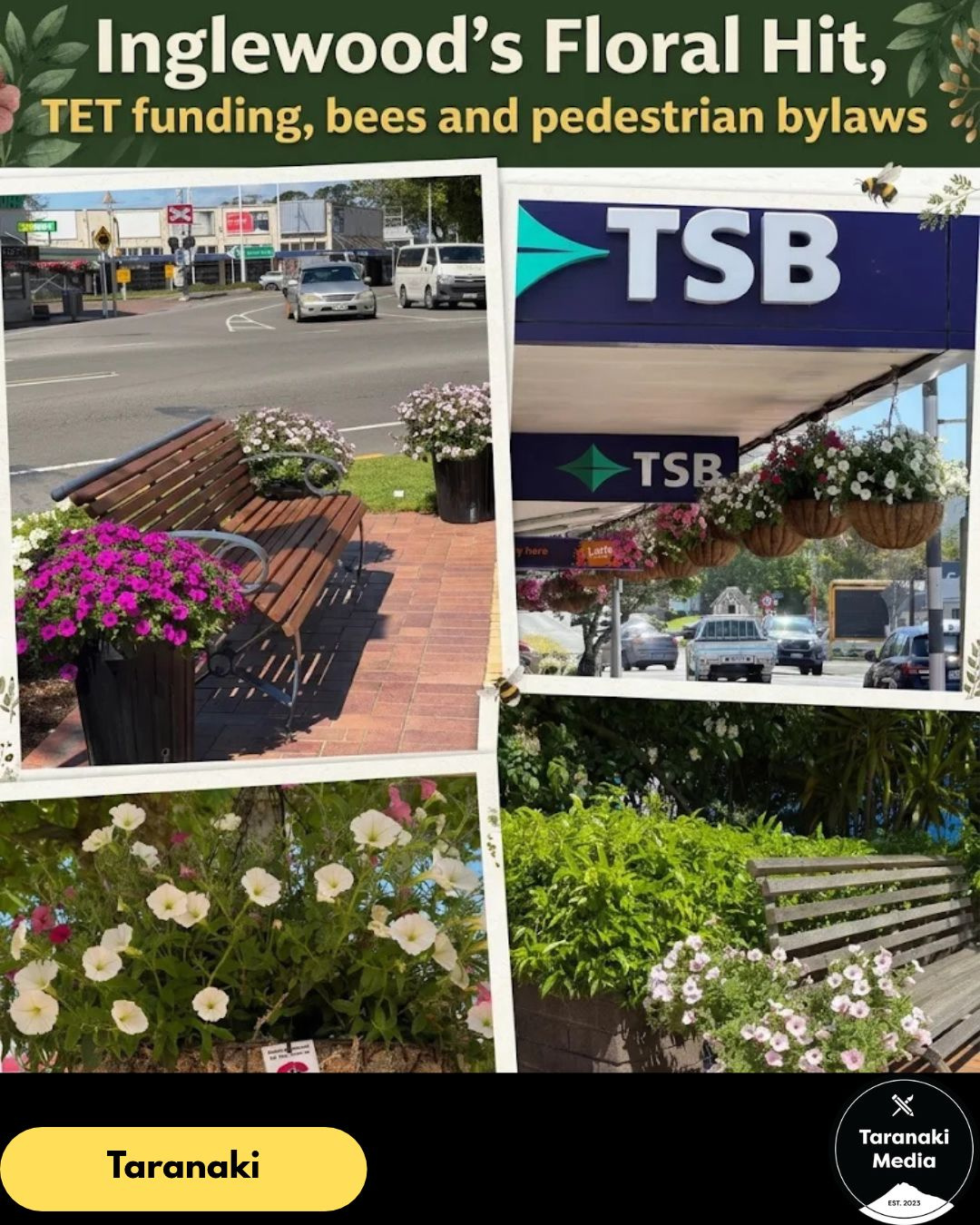

TET Cash, Footpath Bylaws and Bees: The Hard Facts Behind Inglewood’s Floral Hit
Motorists driving through Inglewood hit a bright wall of petals from 120 hanging flower baskets and street pots lining the main strip.
Across a compact 3.18 square kilometres and roughly 3,970 residents in North Taranaki, that puts about 30 floral displays on the street for every 1,000 locals, or roughly one display for every 33 people.
At the core of that operation sits Inglewood First Trust, a community-led group running town beautification, bunting, local events and promotion for more than two decades.
Much of that relentless energy comes from the passionate drive of chairperson and former New Plymouth District Councillor Marie Pearce, who received a King's Service Medal in the 2025 New Year Honours for services to local government and the community.
Pearce's hands-on determination keeps volunteers hauling hoses, checking brackets and tending plants through whipping Taranaki wind, rain and sun.
Generous funding backs that grit, giving Inglewood a funding edge most small towns would envy. Just along Rata Street at number 84 sits the Taranaki Electricity Trust (TET), established in April 1993 when New Plymouth Energy merged with the Taranaki Electric Power Board to return investment earnings to the old power board area.
Publicly released TET records show annual grants of $99,000 approved for Inglewood First Trust across recent financial years, including the years ended 30 June 2024, 2025 and 2026. Those grants back Inglewood First Trust's operating costs, promotion and beautification of Inglewood, sitting alongside separate project allocations in TET's records such as $15,000 approved in February 2026 toward hosting AmeriCARna 2026, subject to quotes.
According to Stats NZ there are 294 businesses and 1,584 private dwellings in Inglewood. So a $99,000 annual grant works out to roughly $337 per business or $24.94 for every resident in town.
Local property and business owners also have access to targeted New Plymouth District Council (NPDC) programmes, including the Main Street Fund and the Built Heritage Protection Fund, which help fund shopfront upgrades, streetscape improvements and heritage preservation along the commercial strip.
Putting 120 flowering baskets and large pots beside footpath seats is a major operation. Under NPDC's Activities in Public Places Bylaw 2025, items placed on, above or over a public place must not impede or cause an undue obstruction to pedestrian or vehicular traffic, constitute a danger to people or property, or block access to adjoining properties, and occupying a public place generally requires council authorisation or a licence to occupy.
Problems can arise if large pots squeeze walking room beside seats for people using wheelchairs, mobility scooters or prams, if trailing foliage spills across the path or hangs low, or if brackets, chains or pots become loose, top-heavy or prone to dropping debris and water in strong gusts.
No publicly reported formal complaints or enforcement actions have surfaced regarding the displays beside footpath seats.
Those compliance and maintenance pressures must be balanced against strong aesthetic, community and ecological upsides. Visually, 120 floral displays break up hard asphalt and shopfronts along State Highway 3. It's also a positive first impression for tourists. The flowers also add colour beside Inglewood's 12 protected heritage buildings.
Environmentally, clustering 120 blooming baskets and pots creates regular nectar and pollen pit stops for honeybees and native pollinators moving between home gardens and green spaces.
Put Inglewood next to other New Zealand towns and the funding and scale of the floral displays stand out as impressive. Ōtorohanga has an urban population of about 3,240 and leans heavily into its Kiwiana identity alongside verandah hanging baskets and street lighting along Maniapoto Street, putting its main street scale in a similar small-town bracket to Inglewood's 120 displays.
Further south, Whanganui serves a district population of roughly 49,200, more than 12 times Inglewood's population, and spreads floral features, heritage streetscapes and events like Whanganui In Bloom across a much wider urban footprint. Whanganui District Council Long-Term Plan documents show the council moved Mainstreet hanging flower baskets to a summer-only display capped at $47,000 plus GST, shifting funding from a 50/50 split to 25% from general rates and 75% from a central business district targeted rate.
Across NZ main street beautification generally splits between Business Improvement District targeted rates on commercial properties, tight general council rates, or community-trust grants paired with volunteer graft. Ring-fenced TET grant funding lets Inglewood First Trust plan seasonal displays without hitting local shopkeepers with a mandatory targeted rate levy, even as volunteers and council rules keep watch over safety, weather wear and stray damage.
What do you think of Inglewood's floral hit and main street beautification?