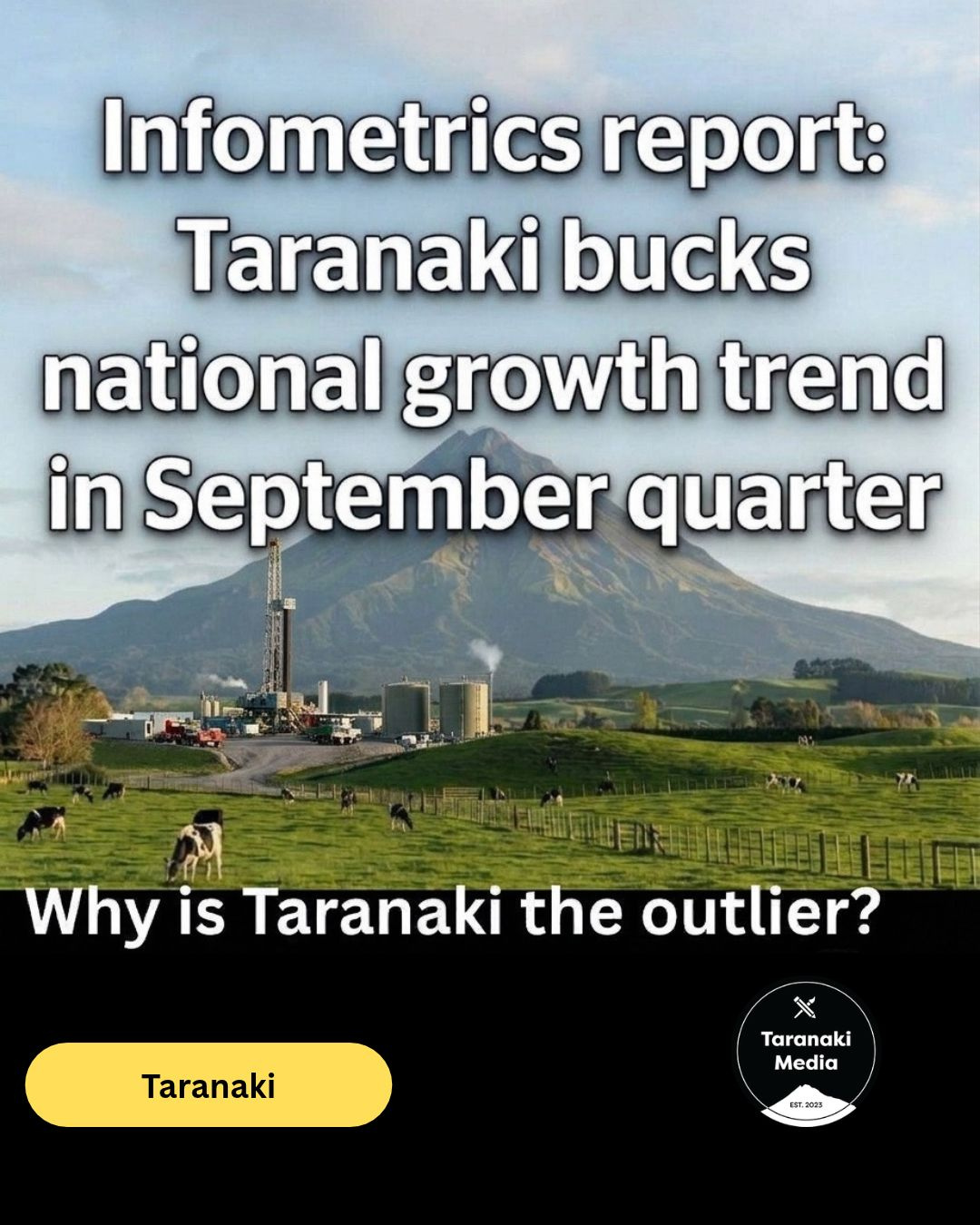

Taranaki was the only regional economy in New Zealand to contract during the September 2026 quarter.
According to the latest Infometrics Quarterly Economic Monitor, released on November 19, 15 of New Zealand's 16 regions recorded economic growth over the three months to September. National economic activity rose 2.1 percent over the year, with Infometrics Principal Economist Nick Brunsdon noting that most regions grew by at least two percent in the quarter."Taranaki was the only regional economy to contract this quarter, driven by declining production from ageing gas fields," Brunsdon said in the Infometrics media release.
The contraction marks a sharp turnaround from the region's most recent post-pandemic high point. Infometrics Quarterly Economic Monitor historical tracking shows Taranaki's annual GDP growth last peaked in the year to June 2023 at 2.6 percent, following strong business expansion that saw local business unit growth peak at 3.4 percent in the year to September 2022. During that 2022–2023 window, resilient energy output, strong post-lockdown consumer spending, and high primary sector returns kept the region outperforming many parts of the country before tighter monetary policy and declining gas reserves began weighing on local output.
Mining and energy remain central pillars of the Taranaki economy. Infometrics regional data shows mining accounts for 11.5 percent of Taranaki's gross domestic product, worth more than $1.38 billion, compared with just 0.7 percent nationally. Manufacturing, which includes major petrochemical and energy processing operations around New Plymouth and Waitara, makes up another 12.2 percent. When output from offshore and onshore gas fields drops, the slowdown flows quickly through local engineering firms, transport operators and service contractors.
The latest figures arrive amid broader caution across the region's workforce and housing market. Infometrics data shows productivity in Taranaki fell 0.7 percent over the past year, while national productivity edged up 0.3 percent. Business unit numbers in the region grew 0.8 percent in the year to June, trailing the national rate of 1.2 percent.
Nationally, Infometrics described the broader economic upturn as slow and patchy. Job growth across New Zealand remains sluggish, and Brunsdon warned that employment gains are still a couple of quarters away as businesses wait for sustained demand before taking on new staff. High fuel prices linked to the conflict in Iran have also squeezed household budgets, with inflation-adjusted retail spending volumes falling 0.4 percent nationally over the past year.
A lacklustre housing market has added further drag. National house values eased 0.9 percent in the September quarter, following earlier sluggish sales volumes across Taranaki, Canterbury and Otago.Despite the downturn in the energy sector, Taranaki's primary industries are offering a vital buffer from North Taranaki farms through to South Taranaki dairy country. Agriculture, forestry and fishing account for 14.2 percent of the region's economy, worth roughly $1.71 billion.
Strong global demand has lifted beef prices by 24 percent and lamb prices by 25 percent over the September year, while Fonterra's recent move to lift its 2026/27 forecast milk price past the $10 mark is set to inject more than $1.7 billion into the province.
For now, the Infometrics figures highlight the dual-speed nature of Taranaki's economy, where strong returns behind the farm gate are working to offset the structural decline of traditional oil and gas extraction.How are you seeing the local economy play out in your sector across Taranaki? Share your thoughts in the comments below.