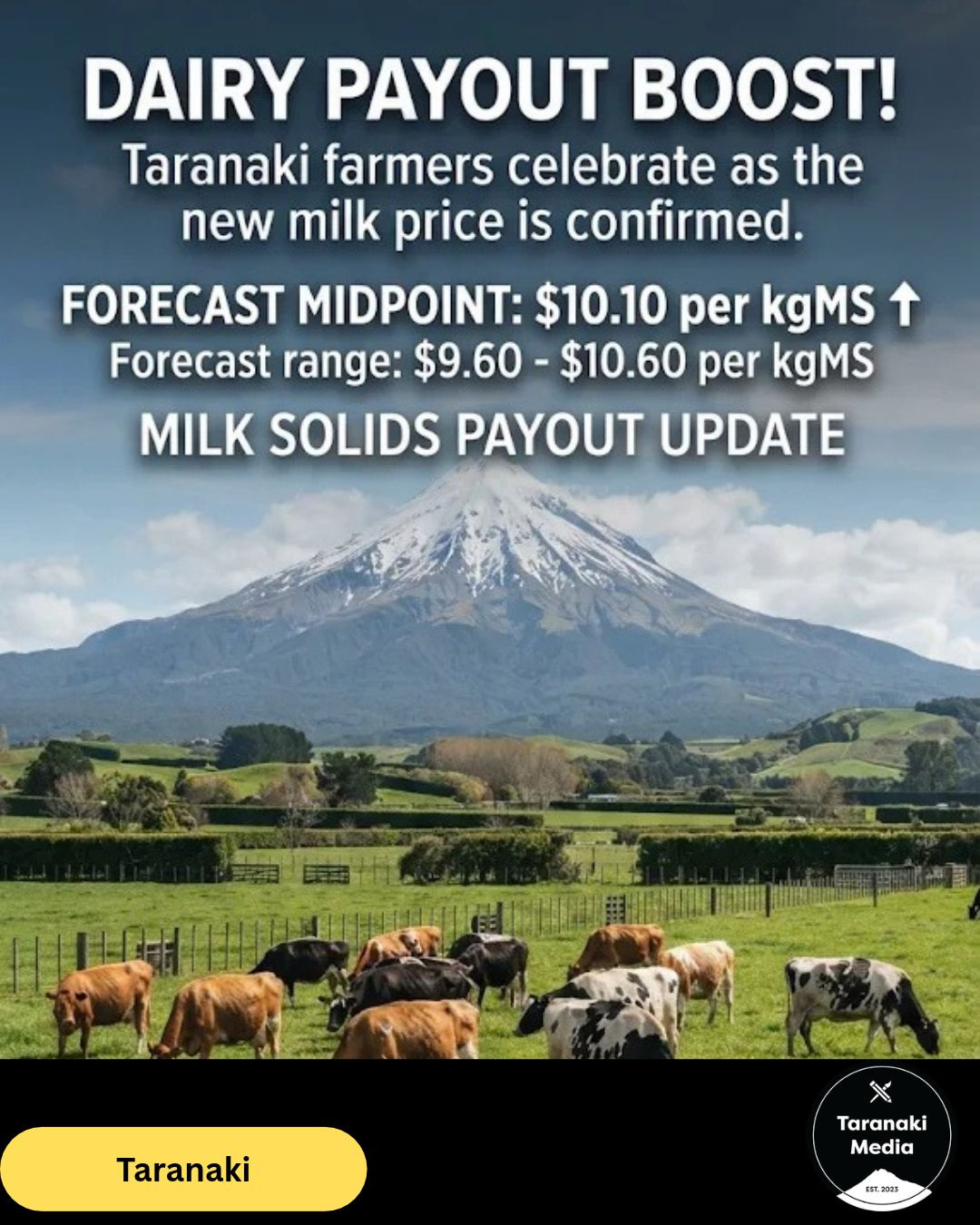

Fonterra lifts 2026/27 forecast milk price past $10 mark, giving Taranaki a $1.73 billion boost.
Taranaki's rural economy is set for a major cash injection after Fonterra lifted its 2026/27 season forecast Farmgate Milk Price midpoint past the $10 threshold yesterday. In an NZX market disclosure on Friday November 20, the dairy co-operative raised its midpoint by 35 cents, moving it from $9.75 to $10.10 per kilogram of milksolids (kgMS). Fonterra also tightened its projected forecast range from $9.00–$10.50 to $9.60–$10.60 per kgMS.
This marks the co-operative's second upward revision in just three weeks, following a 25-cent increase on October 30. The forecast organic milk price remains unchanged at a $15.25 per kgMS midpoint.
In a media release, Fonterra chief executive Richard Allen said the improved forecast reflects sustained demand for milk powders and solid progress in contracting the co-operative's sales book during New Zealand's peak spring production window.
“Whole and skim milk powder prices have continued to improve since our update last month, underpinned by strong Chinese buying and resilient demand across Southeast Asia, the Middle East and Africa," Allen said.
He noted those gains were partially offset by softening milk fat prices in recent Global Dairy Trade events, alongside foreign exchange volatility across the remainder of the season. "Our focus is firmly on delivering value through both the Farmgate Milk Price and earnings, using scale and flexibility to direct our farmers' milk into products and markets with the most valuable demand," Allen said.
For Taranaki, where dairy farming underpins regional prosperity, the price lift arrives at a critical juncture. Economic consultancy Infometrics estimates the total provisional dairy payout for the Taranaki region in the 2026/27 season at approximately $1.733 billion. South Taranaki alone accounts for around $1.15 billion of that regional total. Dairy accounts for 7.8 percent of Taranaki's total Gross Domestic Product (GDP), according to DairyNZ's 2026 sector data.
In South Taranaki, one in every four jobs is directly tied to the dairy industry.
Infometrics data shows Taranaki is home to an average of 443,133 milking cows, with DairyNZ's latest 2025/26 statistics putting the region's average herd size at 316 cows. At the updated $10.10 midpoint, an average Taranaki herd producing roughly 394 kgMS per cow stands to generate around $1.25 million in gross milk revenue this season. That cashflow is acting as a vital shock absorber for the wider province.
While Taranaki's overall GDP contracted by 0.5 percent in the year to December 2025 due to a shrinking oil and gas sector, strong agricultural returns have kept regional unemployment at 4.5 percent, well below the national average of 5.3 percent. By 2024, dairy products had already overtaken oil and gas to become Taranaki's top export earner, bringing in $1.8 billion compared to $610 million from energy.
Local rural contractors, engineers, veterinarians, and retailers from Inglewood and Stratford down SH3 to Hāwera and along the Surf Highway (SH45) will feel the flow-on effects as farmers gain confidence to pay down debt and invest in maintenance.
However, financial analysts warn that higher payouts are not a free pass for on-farm spending. Benchmarking figures published in Farmers Weekly this month show farm operating costs have risen sharply, climbing 15 percent among sharemilkers alone over the past year, driven by higher feed, compliance, and servicing expenses.
National milk collections are tracking strongly, up 3 percent season-to-date, with Fonterra forecasting full-season collections just above 1.6 billion kgMS. Farmers have also locked in record volumes on fixed-price contracts, exceeding 125 million kgMS nationwide, to protect margins against potential late-season weather shifts or currency swings.
With the 2026/27 payout sitting just shy of the final $10.16 per kgMS payout achieved in the 2024/25 season, Taranaki's agricultural backbone remains firmly in the driver's seat of the regional economy.
How will this latest payout lift affect your farm or local business in Taranaki?