
Four Big Moments That Put Taranaki on the World Stage
From the Māui Gas Discovery to Hollywood: Taranaki's Global Spotlights
Landmark Events That Took Taranaki's Name Around the Globe
Four defining moments across energy, cinema, music and sport have carried Taranaki's name to global audiences. From a massive offshore gas find in the Tasman Sea to blockbuster film sets, world music festivals and international stadiums, these milestones show how a compact New Zealand region repeatedly drew worldwide attention.
Taranaki has always had a strong sense of place, framed by the cone of Mount Taranaki and the meeting of coast, farmland and bush. Even so, there are moments when local life suddenly intersects with international news, television broadcasts and overseas visitors.
Discovery of the Māui gas field in 1969
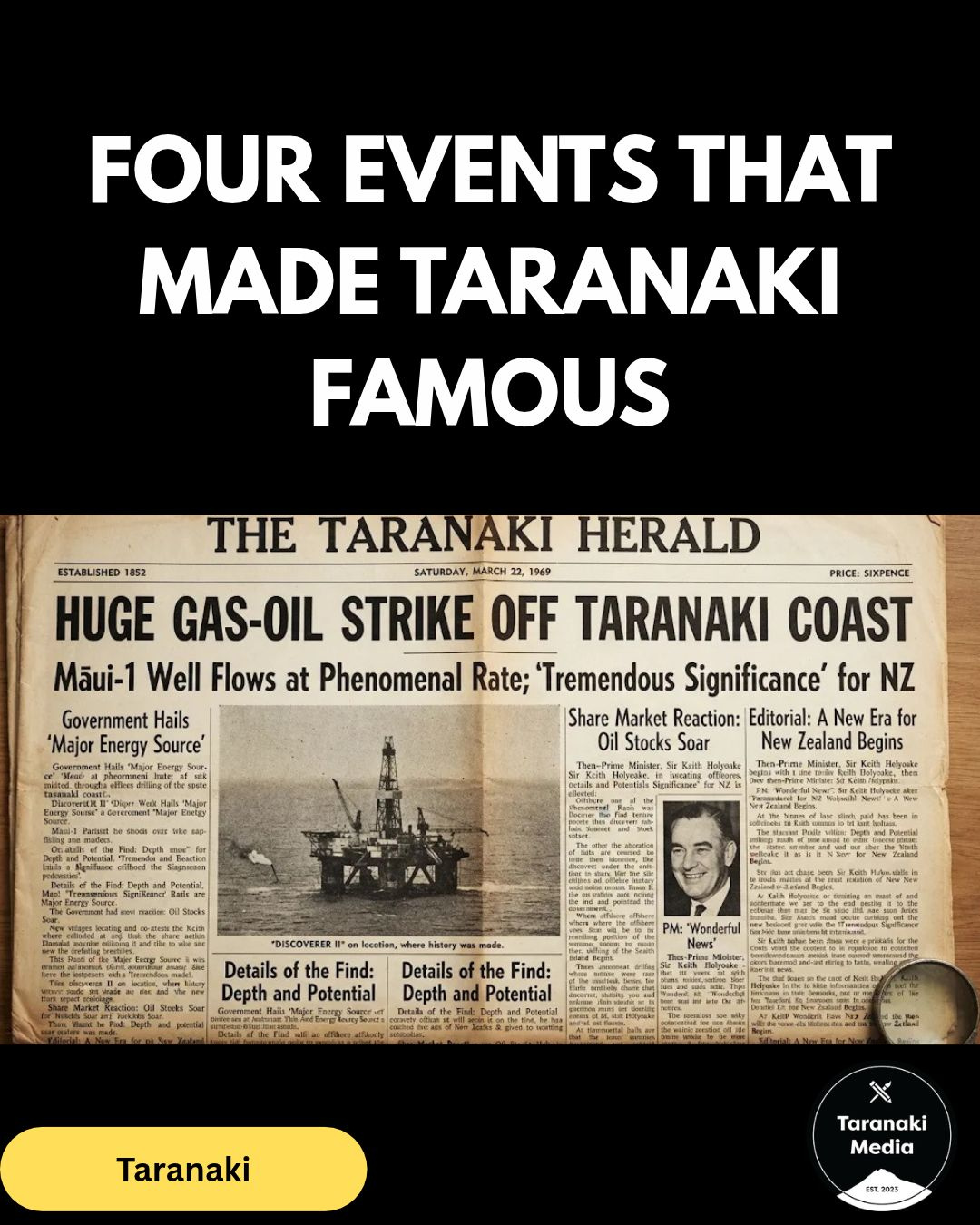
In early 1969, offshore drilling by the ship Discoverer II uncovered the Māui gas and condensate field roughly 33 kilometres off the Taranaki coast. Identified by the Shell, BP and Todd consortium, the find was more than eight times the size of the onshore Kāpuni field and stood out as a major resource on an international scale.
Te Ara Encyclopedia of New Zealand notes that the discovery reshaped New Zealand's energy planning, particularly after the 1973 oil price shock. It paved the way for the Māui A platform in 1979 and Māui B in 1993, alongside pipelines and industrial plants linked to the region.
For Taranaki, the Māui field brought decades of engineering work, investment and national significance. Piping gas across the North Island and building industrial plants in Taranaki placed the region at the centre of national energy engineering, turning local whānau, tradespeople and businesses into key players in how New Zealand powered its homes and industry.
Filming The Last Samurai in 2003
Hollywood crews arrived in early 2003 to shoot The Last Samurai across Taranaki, using the cone of Mount Taranaki as a stand-in for Mount Fuji. Filming took place at sites including Lake Mangamahoe and the Uruti Valley, where surrounding bush and landscapes helped recreate 19th-century settings for the camera.
Movie star Tom Cruise and directors Edward Zwick and Marshall Herskovitz took part in local welcome events, bringing an unmistakable Hollywood buzz to New Plymouth and surrounding districts. Many residents still remember spotting film crews, catching glimpses of stars around town or hearing stories from family members who worked on set.
Hundreds of locals worked alongside the production as extras, crew and support staff, while the region watched global cinema spotlight familiar Taranaki scenery. For a few months in 2003, the eyes of the film world were fixed on the mountain and its valleys.
Becoming the New Zealand home of WOMAD in 2003
In 2003, New Plymouth's Brooklands Park and the Bowl of Brooklands became the permanent New Zealand home of the WOMAD (World of Music, Arts and Dance) festival. Instead of a one-off visit, the move gave the region an annual international gathering that quickly became part of the local calendar.
Te Ara Encyclopedia of New Zealand notes that the multi-stage festival pairs international musicians and performers with workshops, food and craft stalls beside native bush and a small lake. That setting gives the event a character that feels distinctly New Plymouth while welcoming sounds and traditions from around the world.
Each March, the gathering brings global artists and large crowds to New Plymouth. Generations of locals have grown up with the sounds of WOMAD drifting through Brooklands Park, turning a world-famous festival into a shared annual memory across the region.
Hosting the 2011 Rugby World Cup
New Plymouth stepped onto the international sporting stage in September 2011 by hosting three pool matches during the Rugby World Cup at Stadium Taranaki, known as Yarrow Stadium. Supporters filled the stands and streets as international teams and visiting fans arrived in town for world cup rugby.
The matches played at Stadium Taranaki in September 2011 were Ireland against the USA, Russia against the USA, and Wales against Namibia. Each game brought international broadcast crews, visiting supporters and global rugby attention straight into the heart of New Plymouth.
Tournament records show the 2011 event was the largest sporting tournament held in New Zealand, drawing 133,000 overseas visitors across 12 host cities. Broadcasting those matches worldwide put Taranaki rugby and New Plymouth directly in front of international fans, leaving behind vivid memories of flags, crowds and big-match atmosphere.
Looking back at 1969 and 2003 through to 2011, each of these moments showed what happens when international scale meets local Taranaki life. Which of these four moments stands out most to you, and what other events from across the coast, South Taranaki or North Taranaki do you remember?