
Contractors are replacing "Tim Tam" concrete cycleway separators with rubber alternatives along a stretch of Devon Street, as part of a contentious NPDC trial that aims to test alternative safety designs.
Completed in July 2025 under the previous government's Transport Choices programme, the initial cycleway design drew immense opposition when it was first proposed.
A group of residents and business owners affected by the changes heavily criticised the layout, which featured concrete separators, widespread removal of carparks and controversial plans to place bus stops within the main roadway, meaning traffic would be blocked whenever the stops were in use.
Although the plans were adjusted following community consultation, including a switch to more traditional bus stops which allowed traffic to pass when in use, the remaining infrastructure continued to spark community backlash.
Many motorists argued the heavy concrete blocks, widely known locally as "Tim Tams", damaged vehicle rims and tyres while narrowing traffic lanes.
Locals and business operators in the area also reported drops in property values and retail trade due to the missing car parks.
This frustration culminated in multiple petitions containing thousands of signatures calling for a complete reversal of the changes.
During local body elections towards the end of last year, current New Plymouth Mayor Max Brough campaigned strongly on completely removing the concrete separators and returning the road to its previous layout.
The issue came to a head during a New Plymouth District Council meeting in December 2025, where Council staff presented five options for the state highway corridor.
These included monitoring the current design, replacing the “Tim Tams” with rubber alternatives, removing the physical separators to retain painted cycle lanes, a partial removal of the concrete blocks, or completely removing all separators to reinstate car parking.
During the meeting, Brough proposed a compromise to progressively replace all concrete blocks with rubber dividers, which he dubbed "Mallowpuffs", however his motion failed to gain enough support.
Deputy Mayor Murray Chong then put forward a motion for the fifth option to completely remove all separators and return the road to its original state, but that vote also lost after staff warned full removal and reinstatement of car parking could carry an unbudgeted cost of $1.63 million.
Enough councillors eventually backed a motion to launch a targeted trial between Morley Street and Belt Road.
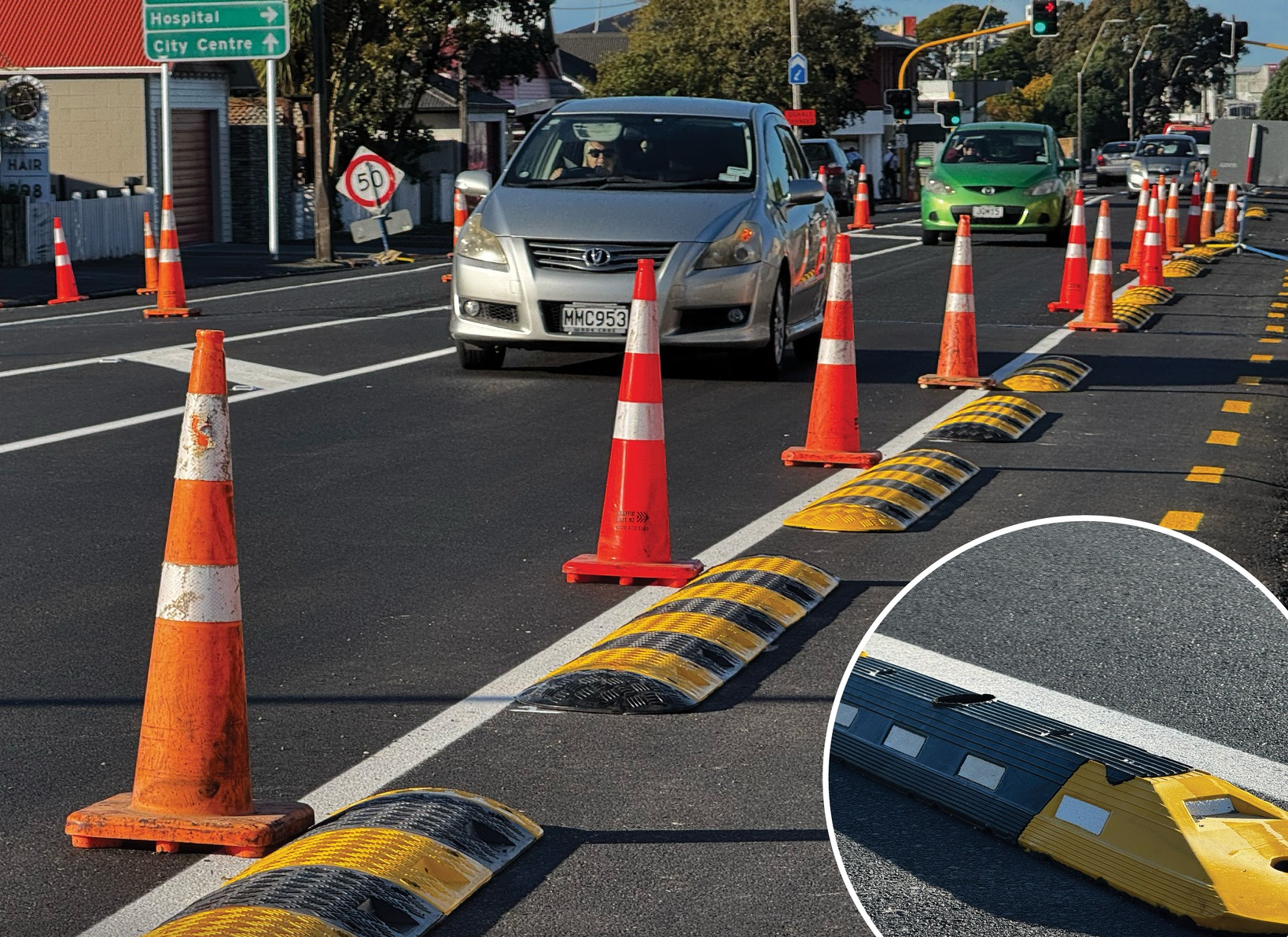
The trial involves replacing the concrete separators with rubber alternatives that vehicles can cross if needed without sustaining damage, then monitoring the impacts before making a final decision in September 2026.
Road crews have begun fitting lower, narrower rubber humps and dedicated rubber separators (both pictured here) that are spaced further apart than the original concrete dividers.
Council documents state this design allows vehicles to safely drive over the separators during tight spots or when pulling aside for emergency services.
The adjustments have been timed to coincide with a recent NZTA road resealing programme.
As part of the changes, some car parks on the northern side of the transport corridor are being reinstated. Other changes being implemented along this stretch include a wider flush median, a full sized right-hand turning bay at the Cutfield Road intersection, and the reinstatement of a right-hand turn into Morley Street.
While the new rubber dividers aim to address widespread driver complaints, active transport advocates have raised concerns that mountable separators offer less physical protection from traffic. Council staff acknowledged this trade-off but maintain it's a necessary step to find a balanced community solution.
"This trial lets us test new options in real-life conditions," the New Plymouth District Council stated on its official project page. "We want to understand whether the design changes maintain, improve or reduce safety for pedestrians, cyclists and motorists."
Camera monitoring will be used to track user behaviour, traffic flow and cycling uptake in the area over the coming months.
Council staff will compile this data and present a comprehensive report to elected members in September. Elected officials will then review the findings and make a final decision on what happens next with all cycleway infrastructure along the state highway.
Future options could include completely removing all concrete and rubber separators to return the road to its original state, or replacing the remaining concrete blocks with the new rubber alternatives, among other options similar to those presented at the December 2025 meeting.