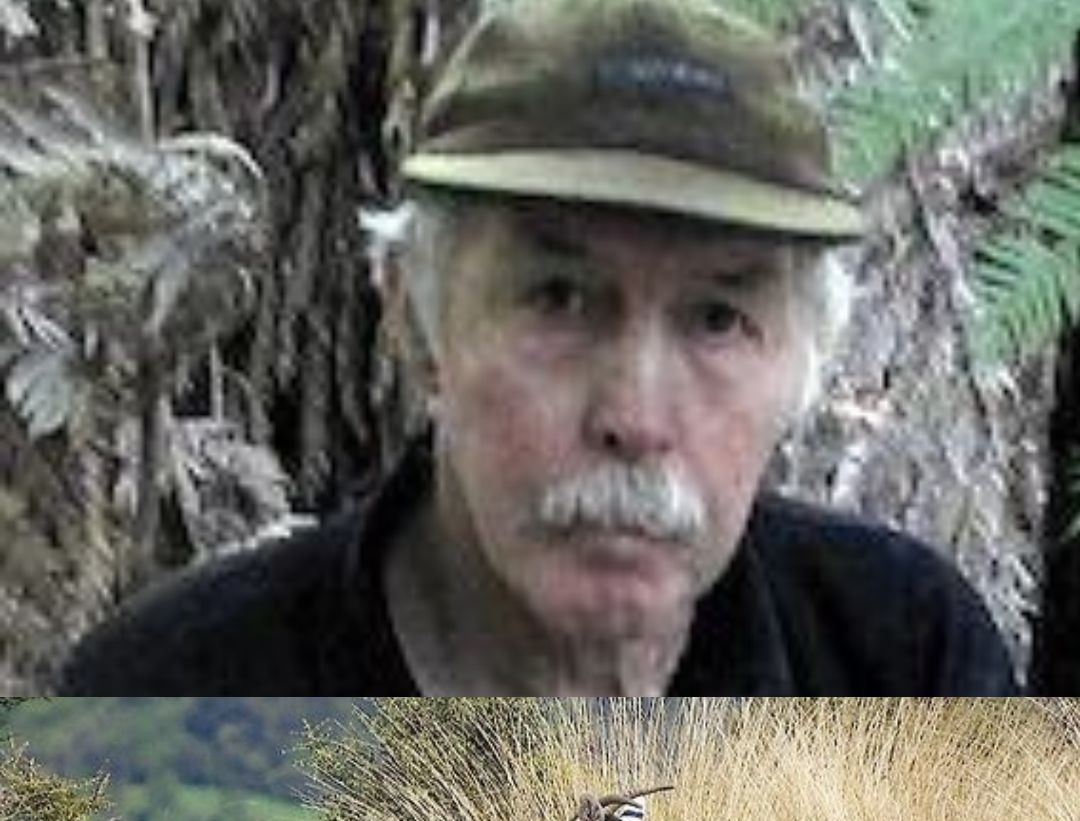

Errol Clince – Taranaki's legendary goat hunter who knew the mountain like his own backyard
There have been plenty of remarkable characters in Taranaki's history, but few could claim to have known the rugged backcountry of Mount Taranaki quite like Errol Clince.
A professional hunter, bushman, adventurer and self-taught engineer, Clince made an extraordinary contribution to the region's history. During 16 years working for the New Zealand Forest Service, he is credited with shooting more than 5,000 wild goats, making him one of Taranaki's most prolific goat hunters.
But there was considerably more to Errol Clince than his ability to track down and eliminate wild goats.
Born in Eltham on 16 February 1953, Clince developed an early interest in hunting and the outdoors. After leaving Stratford High School at 18, he joined the New Zealand Forest Service as a pest controller, undertaking the demanding job of controlling feral goats on Mount Egmont, as Mount Taranaki was then known, and throughout the surrounding national park.
It was a job that required considerable physical fitness, patience, bushcraft and an intimate understanding of the mountain's unforgiving terrain.
Wild goats were a significant problem for the native bush. Introduced to New Zealand by early settlers, they had established themselves in large numbers, browsing on native vegetation and preventing young trees and plants from regenerating.
Clince became exceptionally familiar with the mountain's valleys, ridges, streams and remote bush country. His knowledge was so extensive that he also assisted with technical reports and research relating to the mountain and its wildlife.
More than 5,000 goats over 16 years is an extraordinary tally, particularly when much of the work involved getting into remote country on foot rather than relying on modern technology.
His experience eventually took him further afield, including a stint working as an exterminator on Raoul Island in the Kermadec Islands.
Perhaps his most remarkable achievement, however, had nothing to do with goats.
In January 1974, while hunting in the Pouakai Range, Clince stumbled across the wreckage of a Royal New Zealand Air Force Airspeed Oxford aircraft that had disappeared more than 31 years earlier.
The aircraft had vanished on 23 October 1942 while on a training mission from New Plymouth. Four airmen were aboard: Pilot Officer Rodney Dandy, Sergeant Douglas Martyn, Sergeant Graham Martin and Sergeant Edward Dodson. Despite extensive searches at the time, neither the aircraft nor its crew had been found.
Clince was hunting near Mangorei Stream when he came across the wreckage, including a machine-gun turret, ammunition and a parachute. A discovery involving a human bone eventually established that this was no ordinary abandoned aircraft.
The discovery brought an end to a long aviation mystery and, more importantly, allowed the remains of the four airmen to be recovered so their families could finally have some closure.
His discovery is documented in the Puke Ariki historical collection and in New Zealand Geographic's account of Taranaki. It remains one of the more remarkable stories associated with the mountain.
But Clince was hardly a one-dimensional bushman.
He had an extraordinary mechanical imagination and became a self-taught engineer. Among his interests were building black-powder cannons and constructing two gyrocopters, which he reportedly flew for hundreds of hours.
After his Forest Service career, he became caretaker of the Stratford Mountain House on the eastern slopes of the mountain. It was an appropriate place for someone whose working life and interests had been so closely connected to Taranaki Maunga.
Clince died on 8 September 2014, aged 61, but his contribution to Taranaki's history deserves to be remembered.
There is also an interesting connection between his working life and the more recent conservation success on the mountain.
In 2022, after an intensive programme involving the Department of Conservation, Taranaki Mounga and community hunters, wild goats were finally eradicated from Taranaki Maunga and its surrounding forest. The result was a significant improvement in the health of native vegetation, with young trees and seedlings able to regenerate without being browsed by goats.
It was the culmination of decades of pest-control work by people who understood just how damaging wild goats could be to the mountain's ecosystem.
Clince belonged to an earlier generation of professional hunters who spent long periods working in difficult conditions, often far from roads and civilisation. Their knowledge of the bush was acquired through experience rather than technology.