
The mayor who ruled for 20 years – and was beaten by his neighbour
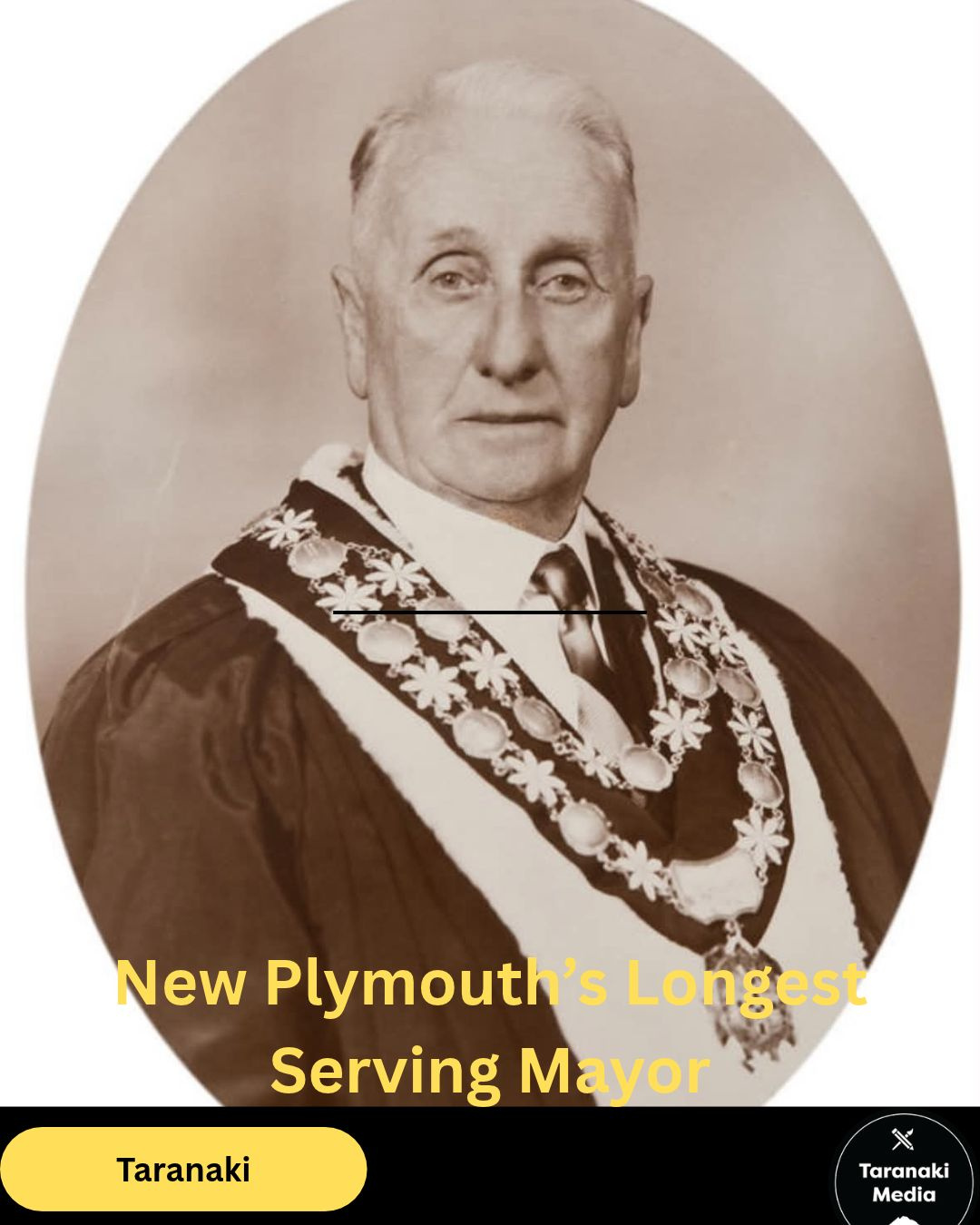
New Plymouth has had its share of colourful mayors, but few have left a bigger mark on the city's history than Everard Robert Cranston Gilmour, better known as E.R.C. Gilmour.
He was mayor for 20 consecutive years, from 1933 until 1953, making him New Plymouth's longest-serving mayor. Yet the end of his remarkable political career came with a twist worthy of a newspaper headline: the man who finally beat him was his next-door neighbour.
Born in Raglan in 1878, Gilmour moved to New Plymouth with his family when he was just nine years old. He attended West End, Fitzroy and Central primary schools, growing up in the town that would eventually become the focus of his extraordinary public life.
His working career began in the office of estate agent P. Corkill. In 1905, he established his own business, developing an interest in property that would remain part of his professional life.
But it was public service that would make his name.
His first attempt at public office came remarkably early. In 1897, aged just 19, he was elected to the Central School Committee. Unfortunately, someone discovered that he was too young to hold the position and he was forced to resign. It was an early political setback, but certainly not the last time Gilmour would put himself forward for public service.
He subsequently became involved in a remarkable range of civic responsibilities. He served on the Taranaki Hospital Board from 1917 until his retirement in 1956, a total of 39 years. He was also chief magistrate for many years and chaired the New Plymouth Patriotic Committee from its establishment during the First World War.
After two unsuccessful attempts at becoming mayor, Gilmour finally won the position in 1933.
He would remain in the mayoral chair through some of the most challenging years in New Zealand's history. His mayoralty covered the Great Depression, the Second World War and the difficult post-war recovery.
For two decades, Gilmour became a familiar figure in the city's civic life. He represented a generation of local leaders for whom public service was not simply a three-year political commitment but a substantial part of their lives.
His longevity was particularly impressive in an era when local politics could be fiercely contested and personal reputations mattered enormously.
However, even the longest-serving mayor is not guaranteed a lifetime appointment.
In 1953, after two decades in office, Gilmour was finally defeated by E.O.E. Hill. And the result had an especially personal dimension. Hill lived next door to him.
As Puke Ariki's historical account records, Gilmour did not have far to go to congratulate his successor.
It is difficult to imagine a more unusual ending to a 20-year mayoralty. After spending two decades leading the city, Gilmour had to accept that his replacement lived just over the fence.
He died on October 29, 1958, aged 80, following a lifetime of outstanding public service.
Today, his name survives in Gilmour Street, in Westown, a modest reminder of a man whose influence on New Plymouth extended well beyond his 20 years as mayor.
There have been many mayors since, but none has yet matched his record.
And perhaps the most memorable detail of all is that New Plymouth's longest-serving mayor was ultimately brought down not by a political outsider from another town, but by the neighbour living alongside him.