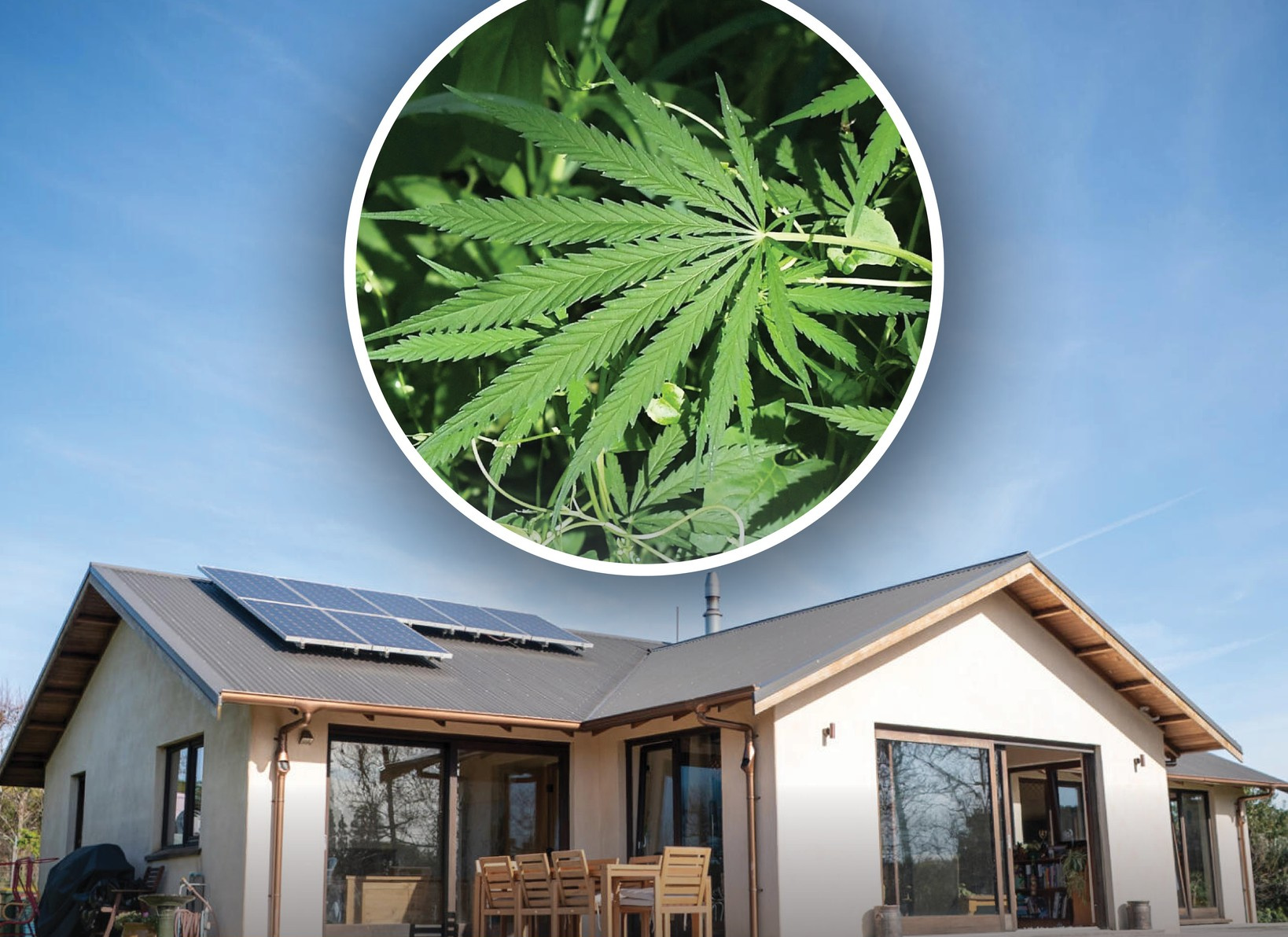

A newly released development plan has identified hempcrete construction as the most immediate commercial opportunity for the emerging hemp fibre industry in Taranaki.
Released by regional development agency Te Puna Umanga Venture Taranaki, the Hempcrete Development Plan acts as a roadmap for the Taranaki Hemp Hub.
This initiative aims to connect locally grown crops, regional processing facilities, and construction materials to create a sustainable local supply chain.
Part of the wider Branching Out project, the strategy follows three years of investigating hemp fibre as a land-use diversification option for the region. Project leaders have spent that time advancing growing trials, processing infrastructure, and workforce training.
Branching Out project manager Michelle Bauer said the plan marked a crucial transition from proving that hemp can grow well in Taranaki soils to creating tangible market opportunities.
"This plan represents a lot of groundwork that's been done over the past few years," Bauer said.
She noted it provided a clear direction to build the confidence, capability, and demand required to sustain a broader hemp fibre sector.
Hempcrete is a low-emissions building material created by mixing hemp hurd with a lime-based binder. Mixing these components creates a product that offers natural insulation, humidity regulation, acoustic performance, and fire resistance.
Modelling included in the development plan showed a standard three-bedroom hempcrete home might cost about 5 percent more to build than a conventional house. However, it also indicated that annual heating demands could drop by approximately 26 percent. Initial cost estimates use conservative productivity assumptions based on an emerging local workforce.
Bauer highlighted that the real potential lied in scaling up from individual residential builds.
"A big opportunity is moving from one-off projects to a pipeline of builds that gives growers, processors and builders the confidence to invest," she said.
Multi-unit housing, retirement villages and new subdivisions could provide the scale required to grow the regional industry.
Venture Taranaki has already started receiving orders for locally grown hemp fibre.
Processing is handled by the Taranaki Hemp Hub's pilot-scale facility, which is currently the only operational hemp processor in the North Island.
Operating at full capacity, the plant could process fibre from about 90 hectares of hemp annually and produce enough hemp hurd to supply materials for 50 average-sized homes each year.
That output is equivalent to almost 10 percent of the annual residential construction activity across the New Plymouth, Stratford, and South Taranaki districts.
While regional supply currently exceeds local demand, the Taranaki Hemp Hub will initially focus on developing markets across the wider North Island as it scales production progressively.
Building capability within the local construction sector is another major focus. Venture Taranaki recently hosted a second sold-out hempcrete construction course to provide builders, designers, and architects with practical training.
One Taranaki homeowner is already preparing to start construction on a hempcrete house using a builder who completed the local training programme.
Future possibilities outlined in the development plan include the manufacturing of hemp fibreboard and panel products.
Bauer said these advanced materials could eventually reduce the reliance on imported building supplies while creating new manufacturing jobs in Taranaki.
"New industries like this develop one step at a time, which is why the Taranaki Hemp Hub has such an important role to play," Bauer said.
She added that hempcrete offered a practical starting point to build demand and lay the foundations for a comprehensive regional hemp industry.