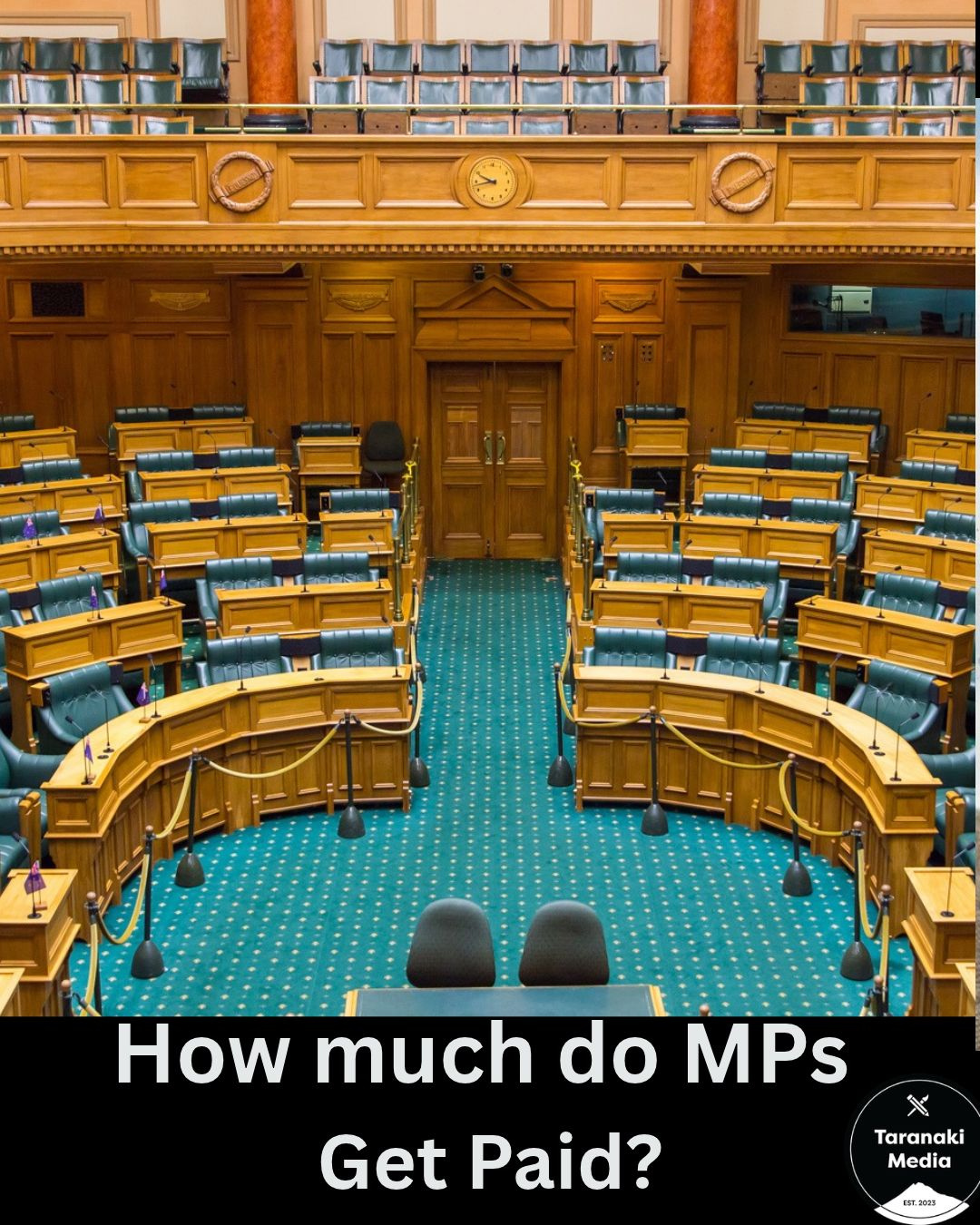

What do New Zealand MPs earn?
Under the published parliamentary remuneration schedule, an ordinary MP earns $181,200 a year from 1 July 2026, equivalent to approximately $3,485 a week before tax.
Politicians with additional responsibilities earn considerably more. A select committee deputy chair receives $186,700, while a committee chair receives $198,600. A non-Cabinet Minister earns $276,000, a Cabinet Minister $327,100, the Deputy Prime Minister $369,800 and the Prime Minister $520,500. The Speaker receives $327,100, while the Leader of the Opposition earns $309,000.
These salaries are set by the independent Remuneration Authority, rather than MPs voting themselves pay rises.
The extra allowances
On top of their salary, ordinary MPs receive an annual expense allowance of $19,300. This covers costs associated with parliamentary duties, including entertaining constituents, meals, koha, gifts, flowers and other official expenses. It is intended for work-related expenditure, not simply extra personal spending money.
MPs also have access to a substantial retirement savings subsidy. Under parliamentary superannuation rules, eligible members can receive a contribution worth up to 20 per cent of their salary, provided they contribute to an approved retirement scheme.
The contribution is calculated at 2.5 times the MP's own contribution. An MP contributing 8 per cent of their salary qualifies for the maximum subsidy. Based on a salary of $181,200, this is worth up to $36,240 annually before withholding tax.
What is the whole package worth?
Combining salary, the expense allowance and the maximum retirement subsidy gives an ordinary MP a headline annual package of approximately $236,740. That comprises $181,200 in salary, $19,300 in expenses and a potential $36,240 retirement subsidy.
This is not take-home pay. The expense allowance is intended for official costs, and the retirement subsidy requires personal contributions. The calculation also excludes travel, accommodation, parliamentary staff and office support.
Travel and accommodation
Another significant part of the package is travel. MPs are entitled to publicly funded domestic travel for legitimate parliamentary business, including journeys between Wellington and their electorates, attending meetings and visiting constituents.
Accommodation assistance is also available to MPs who live outside Wellington but need to spend considerable time in the capital.
_________________________________________________________________________
From £240 to $181,200: How MPs' pay compares with ordinary New Zealanders
In 1900, a New Zealand Member of Parliament earned £240 a year. Today, an ordinary MP's salary is $181,200. But perhaps the more interesting question is how parliamentary pay has compared with the wages of ordinary New Zealanders over the past 126 years.
When an annual parliamentary salary of £240 was introduced in 1892, it was intended to make politics accessible to working men who otherwise could not afford to spend time away from their occupations.
In 1900–01, the average annual wage for adult male workers was approximately £82. An MP therefore earned nearly three times as much as an ordinary male worker.
By 1921, an MP's salary had risen to approximately £1,000, compared with average annual earnings of around £453. That was about 2.2 times the average wage. During the Depression, parliamentary salaries were reduced. By 1931, an MP earned approximately £810, compared with average earnings of £446, narrowing the gap to about 1.8 times.
In 1944, the salary was £500, with an additional £250 tax-free expenses allowance. The distinction between salary and expenses is important when comparing MPs' actual earnings with those of ordinary workers.
The post-war decades brought further increases. An MP earned £900 in 1951, £1,500 in 1961 and £2,150 in 1964. By 1978, after New Zealand's change to decimal currency, the salary had reached $18,000.
By 1989, an ordinary MP was earning approximately $61,000 annually, compared with average annual earnings of $26,860. Politicians were therefore receiving about 2.3 times the average worker's income.
The last published parliamentary salary determination set an ordinary MP's annual pay at $181,200 from July 2026. Stats NZ reported average weekly earnings of approximately $1,730 for full-time equivalent employees in June 2026, equivalent to $89,960 annually. An MP was therefore earning roughly twice as much.
Using median wages and salaries instead, the comparison is even greater: an MP's salary was approximately 2.46 times median annual earnings.
The $181,200 figure was specified until polling day at the November 2026 election. A replacement determination is needed for the new parliamentary term.
In 1900, it was nearly three times the average male wage; today, it is about twice average full-time equivalent earnings.