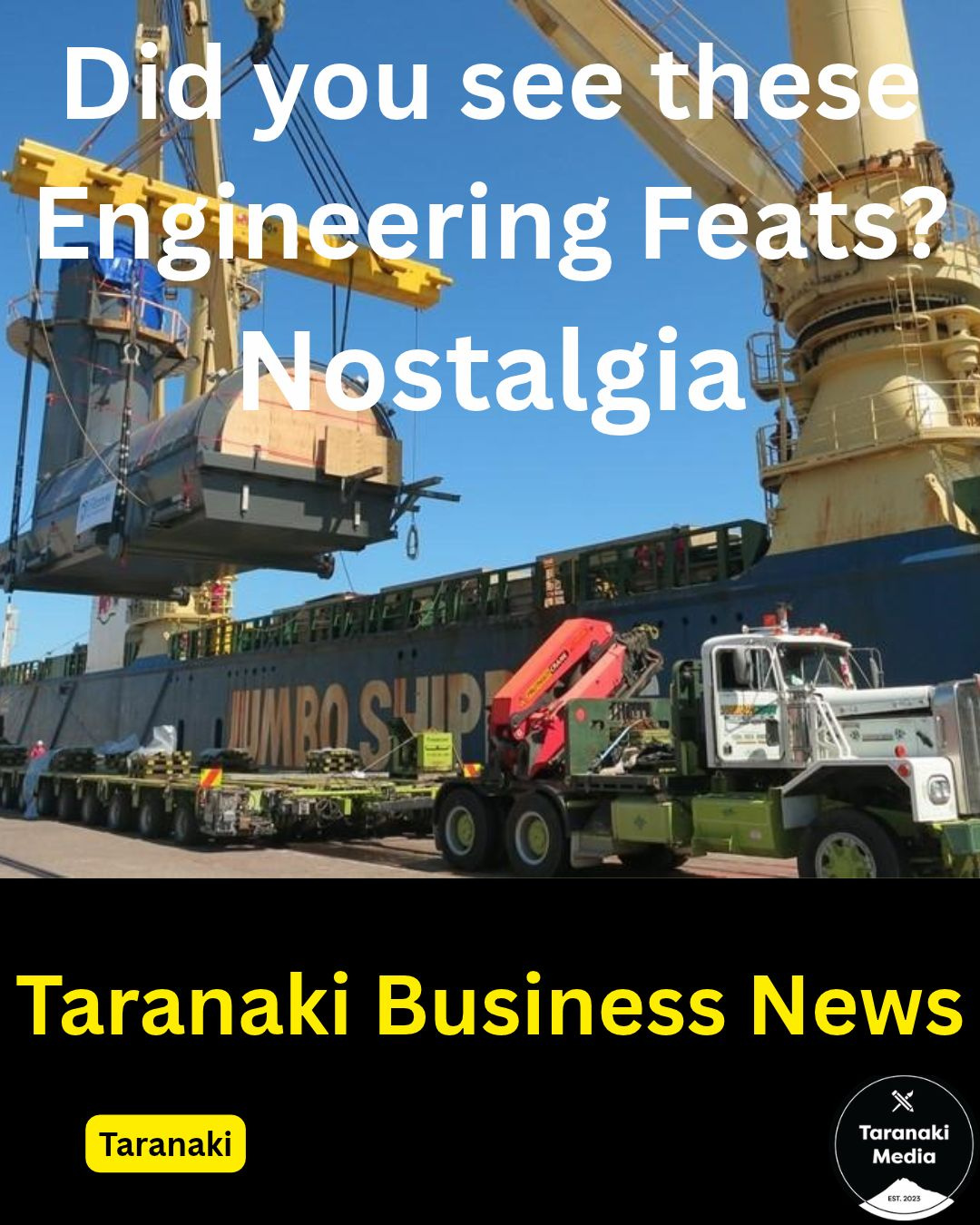

Taranaki's Engineering Giants: The Incredible Structures That Have Travelled Through Port Taranaki
Some of the biggest and most expensive engineering projects ever built in New Zealand have started their journey to the world from an industrial workshop in New Plymouth.
Most people driving through New Plymouth would probably never imagine that some of the enormous engineering structures travelling along its roads are worth millions of dollars and are destined for major industrial developments thousands of kilometres away.
Yet Taranaki has developed an international reputation for heavy engineering, with companies manufacturing extraordinary structures that are too large to be transported by conventional trucks. Instead, they require specially designed trailers, extensive road planning, traffic management and sometimes months of preparation before they can be delivered to Port Taranaki and loaded aboard specialist cargo ships.
One of the most impressive examples has been the work of Fitzroy Engineering, now known as DIALOG Fitzroy.
And the latest example is particularly impressive, with three enormous ammonia storage tanks recently transported through New Plymouth for export to Australia.
Three $3 million ammonia tanks – November 2026
The latest engineering spectacle involved three massive ammonia storage vessels manufactured by DIALOG Fitzroy for Hiringa Energy.
Each vessel measures approximately 35 metres long and 3.5 metres in diameter, weighs 100 tonnes and stands more than five metres high.
Together, the three tanks cost approximately $3 million to manufacture.
Their destination is Moree in New South Wales, Australia, where they will form part of Hiringa Energy's $120 million Good Earth green hydrogen and ammonia project.
The tanks will store ammonia produced using hydrogen generated through renewable electricity and combined with nitrogen from the air. The project is intended to supply green fertiliser to the Australian agricultural industry.
Getting these enormous vessels from the New Plymouth engineering workshop to Port Taranaki was a major logistical exercise.
Each was carried on a specially configured 12-axle trailer, with the complete truck and load measuring approximately 56 metres in length and weighing around 215 tonnes.
The movements took place at night to minimise disruption to traffic. Even with a second truck available to assist with difficult climbs, the operation required considerable planning and driving expertise.
It was a remarkable demonstration of what local engineering and transport companies can achieve.
The $35 million Yolla Mega Module – 2011
Perhaps the most spectacular engineering project ever transported from a New Plymouth workshop to Port Taranaki was the Yolla Mega Module, manufactured by Fitzroy Engineering for an offshore gas platform in Australia's Bass Strait.
This was no ordinary industrial structure.
The completed accommodation and utilities module weighed approximately 650 tonnes, stood 19 metres high and was designed to become a home for more than 40 workers operating on the offshore Yolla-A gas production platform.
It included accommodation, a kitchen, dining facilities, laundry, gymnasium, offices, power and water services, and firefighting equipment.
The project was valued at approximately $35 million and took around 15 months to complete.
Moving something weighing 650 tonnes through the streets of New Plymouth was an extraordinary undertaking. Specialist heavy-haulage equipment was used to transport the enormous structure approximately nine kilometres from Fitzroy's fabrication yard to Port Taranaki.
Once at the port, it was loaded onto a specially designed heavy-lift vessel and shipped across the Tasman to Australia.
It demonstrated that a New Plymouth engineering company could compete internationally for major offshore engineering contracts and deliver structures that would normally be associated with much larger industrial manufacturing centres.
The underwater restaurant destined for the Maldives
Another extraordinary example of Taranaki engineering ingenuity was the construction of an underwater restaurant destined for an island resort in the Maldives.
Fitzroy Engineering was contracted to undertake the steel fabrication and complete much of the technical work needed to turn the unusual structure into a functioning underwater dining facility.
The completed restaurant weighed approximately 410 tonnes and measured 22.5 metres in length.
Its distinctive feature was its enormous transparent acrylic viewing structure, allowing diners to sit beneath the ocean and watch marine life swimming around them.
The engineering involved much more than simply constructing a steel building. Fitzroy undertook the fabrication, installation of the windows and roof, ballasting, air conditioning, electrical work and internal fit-out.
The restaurant took almost 10 months to construct.
Transporting it from the New Plymouth workshop to Port Taranaki required a specially designed double-wide 14-axle trailer. The journey of approximately eight kilometres took four hours.
The completed structure was then shipped to the Maldives, where it was installed on a coral reef.
It was another example of a project that could only be undertaken by companies with highly specialised engineering and fabrication skills.
The enormous oil recycling plant for Queensland
In 2014, Fitzroy Engineering completed another major export project when it constructed a giant oil recycling processing module for the Northern Oil Refinery project in Queensland, Australia.
The dimensions alone were extraordinary.
The module measured approximately 30 metres high, 30 metres long and 18 metres wide.
It was described at the time as the largest single piece of heavy engineering ever to leave New Zealand.
The facility was designed to process up to 100 million litres of waste lubricating oil annually, recovering valuable oil products for reuse.
Fitzroy was responsible for the engineering, procurement and construction of the project, including the processing module and associated facilities.
The project demonstrated that New Plymouth had the capability to manufacture substantial industrial processing equipment for international customers.